

A brushless motor go kart uses an electronically commutated motor instead of the older brushed DC motors found on toy-grade ride-ons. Brushless motors run cooler, waste less battery energy, need almost no routine maintenance, and deliver strong torque from a standstill, which is why nearly every serious electric kart, conversion kit, and DIY build now uses one. This guide explains how brushless motors work, the difference between chain-drive motors and hub motors built into the wheel, how voltage and power ratings affect speed, what a typical setup costs, and how to choose the right motor and controller for your kart.
Part of our Electric Go-Karts guide — explore the full guide →
What Is a Brushless Motor Go Kart?
A brushless DC motor, often shortened to BLDC, has permanent magnets on the rotating part and copper windings on the stationary part. A separate electronic controller switches current through the windings in sequence, so the magnetic field “pulls” the rotor around. There are no carbon brushes rubbing on a commutator, so there is nothing to wear out except the bearings.
On a kart, the motor connects to the battery pack through that controller. The throttle pedal sends a signal to the controller, and the controller decides how much current to feed the motor. Many controllers also handle regenerative braking, reverse, speed limiting, and low-voltage cutoff to protect the battery.
Older brushed motors are simpler and cheaper, and they still appear on budget kids’ karts. But brushes create heat and friction, wear down with use, and lose efficiency as they age. For anything bigger than a small ride-on, brushless is now the default. For the wider picture of how motors fit into electric kart design, see our complete guide to electric go-karts.
Brushless vs Brushed Motors
The practical differences show up in three places: efficiency, maintenance, and control.
Efficiency. Brushless motors typically convert more of the battery’s energy into motion, with less lost as heat. On a kart that means more range from the same pack and less risk of the motor overheating on long runs.
Maintenance. A brushed motor eventually needs new brushes, and dust from worn brushes can build up inside the case. A brushless motor mostly needs its bearings, connectors, and mounting bolts checked.
Control. Because a controller manages every switching event, brushless setups can be tuned. Owners can often adjust acceleration ramps, maximum current, top speed limits, and regenerative braking strength through software or a programming cable.
The trade-off is complexity. A brushless motor cannot run without a matching controller, and wiring the Hall sensors, phase wires, and throttle correctly matters. A wrong phase order can make a motor stutter or run backward.
Best Electric Motor for Go-Karts: our top 3 picks
| Product | Best for | Key features | Price | Buy |
|---|---|---|---|---|
| doinal KR5V 72V 5000W kit | Best overall |
| $389.90as of Oct 27, 2026 7:10 am EDT | Buy now →Check current price |
| doinal 72V 3000W kit | Best 3kW adult conversion |
| $279.90as of Oct 27, 2026 8:03 am EDT | Buy now →Check current price |
| doinal 48V 2000W kit | Best 48V build |
| $259.90as of Oct 27, 2026 8:03 am EDT | Buy now →Check current price |


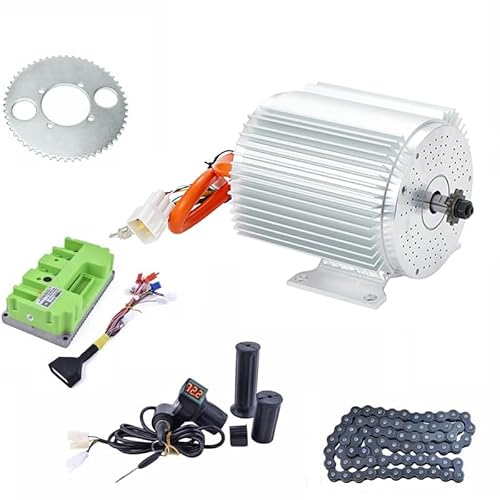
Prices are Amazon’s listed prices as of the date and time shown and are subject to change; the price on Amazon at the time of purchase applies. As an Amazon Associate we earn from qualifying purchases.
Types of Brushless Motors for Go-Karts
Outrunner and inrunner chain-drive motors. These are the most common choice for DIY karts and conversion kits. The motor bolts to the frame and drives the rear axle through a chain and sprockets, just like a gas engine. Gearing can be changed by swapping sprockets, which lets you trade top speed for acceleration. Many kits in the 48V to 72V range use this layout.
Hub motors. A hub motor puts the motor inside the wheel itself. The outer shell, which carries the tire, is the rotor. There is no chain, no sprocket, and no axle-mounted drive hardware. If you searched for a hub motor go kart, this is the design you are looking at. Hub motors are popular on light recreational karts, drift karts, and some kids’ karts because they are quiet and tidy.
Sensored and sensorless motors. Sensored motors carry Hall-effect sensors that tell the controller exactly where the rotor sits. This gives smooth starts from a stop, which matters on a kart that launches under load. Sensorless motors are simpler but can cog or hesitate at very low speeds, so most kart builders prefer sensored versions.
Liquid-cooled and high-power motors. Larger performance karts may use bigger brushless or permanent-magnet AC motors with liquid cooling. These are found on high-speed builds and commercial rental or racing electric karts rather than typical backyard machines.
Hub Motor Go Kart vs Chain-Drive Brushless Motor
The hub-versus-chain decision shapes the whole kart, so it deserves a close look.
A hub motor saves space and removes the chain, sprocket, and tensioning work entirely. It is quiet and needs little maintenance. The downsides are unsprung weight, since a heavy motor now sits in the wheel, and fixed gearing. You cannot change a hub motor’s ratio, so you get whatever torque and speed the winding was designed for. Hub motors also sit closer to dirt, water, and impacts, and replacing one usually means replacing the whole wheel assembly.
A chain-drive brushless motor is mounted on the frame and protected from curb strikes. You can gear it for climbing hills, carrying adults, or chasing top speed, and the motor is easy to swap. The cost is more parts to maintain, more noise, and a chain that needs regular tension checks. Use our sprocket calculator to estimate what a given gear ratio will do with your motor’s rated RPM.
| Feature | Brushed DC motor | Brushless chain-drive | Brushless hub motor |
|---|---|---|---|
| Typical use | Toy-grade and small kids’ karts | DIY builds, conversions, adult karts | Light recreational, drift and kids’ karts |
| Efficiency | Lower | Higher | Higher |
| Gearing | Adjustable if chain-driven | Fully adjustable via sprockets | Fixed by motor design |
| Maintenance | Brushes wear out | Chain, sprockets, bearings | Bearings and wiring only |
| Noise | Moderate | Chain whine | Very quiet |
| Unsprung weight | Low | Low | Higher |
| Typical motor cost | Lowest | Moderate | Moderate, often sold in pairs |
Voltage, Power and Speed
Brushless kart motors are usually sold by system voltage and rated power. Common voltages are 36V, 48V, 60V, and 72V, with continuous power ratings from a few hundred watts up to several kilowatts.
Voltage mainly sets how fast the motor can spin, because a motor’s top RPM rises with the voltage applied. Current, which the controller limits, mainly sets torque. A 48V system with a capable controller is a common middle ground for adult recreational karts, while 72V setups target higher speeds. Our guides to 48V electric go-karts and the batteries behind them go deeper on range and pack sizing.
Keep in mind that the rated power on a listing is often the continuous figure, and peak power can be much higher for short bursts. Listings are not always consistent, so compare the continuous rating, the rated RPM, and the recommended controller current rather than one headline number.
Real-world speed depends on gearing, tire diameter, total weight, battery sag, and the controller’s limits. Two karts with the same motor can differ a lot, so treat seller speed claims as a rough guide.
Choosing the Controller
The controller is half of any brushless system. It must match the motor’s voltage, handle its current draw with some headroom, and support its sensor type. Many kits sell the motor, controller, throttle, and key switch together, which removes most compatibility guesswork.
Two control styles are common. Trapezoidal or square-wave controllers are cheaper and simple. Sine-wave and field-oriented control (FOC) controllers are smoother and quieter and are often more efficient at part throttle. For a kart that will be driven by kids or beginners, a controller with adjustable acceleration ramps makes the machine much easier to manage.
Look for low-voltage cutoff, overcurrent protection, and thermal protection. If you plan to use regenerative braking, confirm the battery and its battery management system can accept charge current safely.
Brushless Motor Go Kart Cost
Prices vary with power, brand, and what is included, but typical USD ranges look like this:
- Small 24V to 36V brushless motor with controller: roughly $80 to $250, suited to kids’ and light karts.
- 48V motor kits around 1 to 2 kW: commonly $150 to $500 including controller and throttle.
- 60V to 72V kits in the 3 to 5 kW range: often $400 to $1,200.
- Hub motor pairs with controller: typically $200 to $900 depending on size and power.
The battery usually costs more than the motor. A lithium pack sized for a powerful motor can match or exceed the price of the whole drive kit, so budget for both together. Our guide to batteries for electric go-karts covers chemistry, wiring, and care.
How to Choose a Brushless Motor for Your Kart
- Define the job. A kids’ yard kart, an adult trail kart, and a fast pavement build need very different power levels.
- Pick the drive layout. Choose a hub motor for simplicity and quiet running; choose chain drive if you want adjustable gearing or plan to upgrade later.
- Match voltage to the battery. Decide on a system voltage first, then buy the motor, controller, and charger to suit it.
- Check mounting. Confirm the motor’s mount pattern, shaft size, and keyway fit your frame and sprocket, or that the hub motor fits your axle and brake layout.
- Prefer sensored motors. Smooth launches make the kart easier and safer to drive.
- Plan the brakes. A stronger motor means a faster kart, so upgrade the mechanical brakes to match. Regen braking alone is not a substitute.
For specific models across power levels, see our roundup of the best electric motor for go-karts.
Installation and Maintenance
Mount the motor on a rigid plate so it cannot twist under load. On chain-drive builds, align the motor sprocket and axle sprocket with a straightedge, and leave a small amount of chain slack. Route phase wires and sensor leads away from the chain and hot or sharp parts, and secure them with ties.
Use connectors and wire gauges rated for the current, and fit a main fuse or breaker plus an easy-to-reach kill switch. After the first few rides, recheck mounting bolts, connectors, and the chain. Ongoing care is light: keep the motor clean and dry, check the bearings for noise or play, and inspect wiring for chafing.
Hub motors need their axle nuts torqued to the manufacturer’s figure and their cables protected where they exit the axle, since that is a common failure point.
Pros and Cons
Pros
- High efficiency and longer range per charge
- Almost no routine motor maintenance
- Strong torque from a standstill
- Programmable acceleration, speed limits and regen
- Hub motors remove the chain entirely
Cons
- Requires a matched controller and careful wiring
- Higher upfront cost than brushed motors
- Hub motors have fixed gearing and add unsprung weight
- Powerful setups need upgraded brakes and batteries
Frequently Asked Questions
Is a brushless motor better than a brushed motor for a go-kart?
What is a hub motor go kart?
How fast is a 48V brushless go-kart?
Can I put a brushless motor on a gas go-kart frame?
Do brushless motors need a special controller?
How long does a brushless kart motor last?
Final Thoughts
A brushless motor go kart is efficient, low-maintenance, and easy to tune, and the real decision is whether a hub motor or a chain-drive motor suits your build. Choose hub motors for quiet, simple recreational karts, and chain drive when you want adjustable gearing and room to grow. When you are ready to compare specific motors and kits, start with our roundup of the best electric go-kart motors.