

The best go kart for 13 year old drivers has to clear a bar most kids’ karts never reach: a stated age range that actually includes 13, enough frame and weight rating for a growing teen, and real brakes. This roundup is for parents shopping for a 13-year-old who has outgrown toddler ride-ons but is not ready for adult machines, whether the riding happens on a driveway, a field or a farm track. Every kart below states an age range that covers 13, or is sold as a youth model, and we show that stated range in each spec table. Our #1 pick is the HHH GK125, a youth gas kart with hydraulic disc brakes, a gas pedal limiter and a parent-held remote engine shut-off.
Part of our Kids Go-Karts guide — explore the full guide →
As an Amazon Associate we earn from qualifying purchases.
How we compared: we compared 12 current Amazon listings (one per product, after dropping color variants and karts whose stated age range stops below 13 or starts above it) on what each listing states about age range, weight limit, top speed, power, brakes and parental controls. We did not test or ride these units. Prices and availability change, so check the live listing before you buy.
| Product | Best for | Key features | Price | Buy |
|---|---|---|---|---|
| HHH GK125 | Best overall |
| $1,435.00as of Oct 27, 2026 6:45 am EDT | Buy now →Check current price |
| TrailMaster Blazer 200R | Best gas kart for ages 10 and up |
| $2,349.00as of Oct 27, 2026 11:56 am EDT | Buy now →Check current price |
| Razor Dune Runner | Best electric for mixed ground |
| $474.99as of Oct 27, 2026 12:12 am EDT | Buy now →Check current price |
| Nasitip 24V Drift Kart | Best drift kart for ages 8 to 15 |
| $249.99as of Oct 27, 2026 11:56 am EDT | Buy now →Check current price |
| X-PRO Rover 110cc | Best two-seat youth kart |
| $1,349.00as of Oct 27, 2026 11:56 am EDT | Buy now →Check current price |
| AceCruisers 24V Drift | Best to share with siblings |
| $319.99as of Oct 27, 2026 11:56 am EDT | Buy now →Check current price |
| Razor Crazy Cart Shift | Lightest drift kart |
| $148.00as of Oct 27, 2026 5:28 am EDT | Buy now →Check current price |
Prices are Amazon’s listed prices as of the date and time shown and are subject to change; the price on Amazon at the time of purchase applies. As an Amazon Associate we earn from qualifying purchases.
The Best Go-Karts for 13-Year-Olds, Ranked
Age 13 sits on a boundary. Plenty of kids’ electric karts on Amazon stop at 12, and many fast karts start at 14 or 16. We kept only listings whose own age wording covers a 13-year-old, then ranked them on the safety and fit details each listing states. Each pick also notes what its listing leaves out.
1. HHH GK125 — Best Overall for a 13-Year-Old

Youth two-seat gas kart with a remote engine shut-off, a gas pedal limiter, hydraulic discs and full suspension.
$1,435.00as of Oct 27, 2026 6:45 am EDT
Check price on AmazonWhy we like it
- Parent-held remote engine shut-off
- Adjustable throttle stop on the gas pedal
- Hydraulic disc brakes and full suspension
- Roll cage and harness for both riders
- Automatic gearbox with reverse
| Specification | Details |
|---|---|
| Stated age range | Youth and kids (no exact range stated) |
| Load rating | About 250 to 270 lb across two seats |
| Top speed | not stated in listing |
| Engine | 125cc air-cooled four-stroke, automatic with reverse, electric key start |
| Brakes and suspension | Hydraulic discs; full suspension |
| Fit | Seat-to-pedal distance 27.5 to 31 inches; 3.5-inch ground clearance |
HHH GK125 — youth 125cc four-stroke, auto plus reverse, remote kill, pedal limiter, hydraulic discs, two seats.
The only design on the shelf with a remote engine cut-off
This is the only kart design among the 12 that includes a parental remote that switches the engine off. It also has a throttle stop on the gas pedal, making it one of the 2 listings with a speed limiter. For a 13-year-old learning on open land, that pairing lets a parent set a crawl-speed ceiling and kill the engine from a distance if needed.
It is one of 5 listings that mention disc brakes and one of 4 with a stated load figure. The 27.5-to-31-inch seat-to-pedal range is the most specific fit measurement on the shelf, so you can measure your teen’s leg length before buying.
The cautions: the listing mixes GK110 and GK125 names, and the kart itself weighs about 300 lb, so it needs a trailer or ramp to move. Some assembly is required, and replacement-parts cover runs for 30 days. A near-identical GK110 is sold under another brand on the same shelf; we list one.
Pros
- Remote engine shut-off for parents
- Pedal limiter caps top speed
- Hydraulic discs and full suspension
- Seats two with harnesses
Cons
- No top speed or exact age range
- Model naming is inconsistent
- About 300 lb kart weight
- 30-day parts coverage
Check HHH GK125 price on Amazon
2. TrailMaster Blazer 200R — Best Gas Kart for Ages 10 and Up

Mid-size youth gas kart for ages 10+, with electric start, reverse and a throttle limiter for speed control.
$2,349.00as of Oct 27, 2026 11:56 am EDT
Check price on AmazonWhy we like it
- Sold as a mid-size kart for ages 10 and up
- Throttle limiter lets parents cap speed
- Electric start and reverse gear
- Arrives mostly assembled in a crate
| Specification | Details |
|---|---|
| Stated age range | 10 and up |
| Rider weight limit | not stated in listing |
| Top speed | not stated in listing |
| Engine | Listed as 212cc 7 hp in one line and 200cc 6.5 hp in another |
| Speed control | Throttle limiter |
| Emissions | Not CARB-compliant (cannot be sold for use in California) |
TrailMaster Blazer 200R — ages 10+, mid-size youth gas kart, electric start, reverse, throttle limiter.
A youth gas kart sized for the 10-plus bracket
Four of the 12 listings are gas karts, and the Blazer 200R is the only one that states a numeric age range. The others call themselves youth karts without saying where youth starts. A stated 10-and-up rating puts a 13-year-old in the middle of the intended bracket, not at its edge.
It is also one of only 2 listings on the shelf that mention a throttle or pedal limiter. That is the feature that makes a gas kart workable for a newer teen driver. Set it low for the first sessions, then open it up as skills improve. The listing says the kart ships nearly assembled, with tires, shocks and fenders already fitted.
The gaps are significant. There is no top speed, no brake description and no weight limit, and the engine is described two different ways in the same listing. Confirm the engine size and brake type with the seller, and plan for fuel storage and oil checks.
Pros
- Numeric age range of 10 and up
- Throttle limiter for parent-set speed
- Electric start and reverse
- Ships largely assembled
Cons
- No top speed, brakes or weight limit stated
- Conflicting engine specs in the listing
- Not CARB-compliant
- Gas upkeep and noise
Check TrailMaster Blazer 200R price on Amazon
3. Razor Ground Force Dune Runner — Best Electric for Mixed Ground

Ages 8+ electric with a 350W chain-drive motor, rear disc brake, rear suspension and knobby pneumatic tires.
$474.99as of Oct 27, 2026 12:12 am EDT
Check price on AmazonWhy we like it
- Stated age range of 8 and up includes 13
- Hand-operated rear disc brake
- Knobby 8-inch pneumatic tires with rear suspension
- 350W chain-drive motor with variable-speed throttle
- Padded bucket seat with a lap belt
| Specification | Details |
|---|---|
| Stated age range | 8 and up |
| Rider weight limit | not stated in listing |
| Top speed | Up to 10 mph |
| Motor and run time | 350W high-torque, chain drive; up to 40 minutes per charge |
| Brakes | Hand-operated rear disc |
| Tires and frame | 8-inch knobby pneumatic tires, rear suspension, steel open frame |
Razor Ground Force Dune Runner — ages 8+, 350W chain drive, 10 mph, rear disc, rear suspension, pneumatic tires.
The only electric pick here that states pneumatic tires and a disc brake
Of the 12 listings we compared, 7 are electric. The Dune Runner is the only one of those 7 that states pneumatic (air-filled) tires, and one of just 2 electrics that mention a disc brake. Air tires and a rear suspension matter for a teen who will ride on grass, packed dirt and broken pavement rather than a smooth garage floor. They absorb bumps that solid plastic wheels pass straight into the frame.
The speed is modest for a 13-year-old at up to 10 mph, which makes it the easier electric choice for families without acreage. It is quick enough to be fun on a lawn or trail and slow enough for a first kart without a dedicated track. Only 6 of the 12 listings state a top speed at all, so having the number in writing is useful in itself.
What it does not state: a rider weight limit, battery voltage or capacity, or charge time. A heavier 13-year-old should confirm the weight rating with Razor before ordering. Steering-wheel throttle and hand brake controls take a short learning session for kids used to pedals.
Pros
- Rear disc brake and rear suspension
- Pneumatic knobby tires for mixed ground
- Stated age range covers 13 with room to grow
- Variable-speed throttle on the wheel
Cons
- No rider weight limit stated
- 10 mph may feel tame for older teens
- Battery specs not listed
- Run time up to about 40 minutes
Check Razor Dune Runner price on Amazon
4. Nasitip 24V Drift Kart — Best Drift Kart for Ages 8 to 15
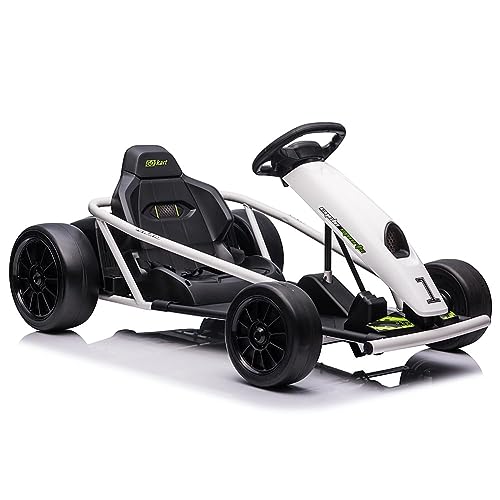
Ages 8 to 15 drift kart with two 300W motors, a 24V 9Ah battery, 8.1 mph and a 155 lb max load.
$249.99as of Oct 27, 2026 11:56 am EDT
Check price on AmazonWhy we like it
- Stated range of 8 to 15 years
- 155 lb maximum load
- Two 300W motors on a 24V 9Ah battery
- Soft start, seatbelt and high/low speed switch
| Specification | Details |
|---|---|
| Stated age range | 8 to 15 years (another line says 6 and up) |
| Rider weight limit | 155 lb (70 kg) |
| Top speed | 8.1 mph, with high and low modes |
| Motor and battery | Two 300W motors; 24V 9Ah |
| Brakes | not stated in listing |
| Tires and seat | EVA front, nylon rear drift tires; 14.3-inch seat width |
Nasitip 24V drift kart — ages 8 to 15, 2 x 300W, 24V 9Ah, 8.1 mph, 155 lb load, soft start.
The highest stated upper age among the electric karts
Only 4 of the 12 listings give a rider weight limit, and this one states 155 lb. Its 8-to-15 age range runs two years past 13, the oldest upper bound of any capped age range we compared. For a teen who will grow over the next couple of summers, that headroom matters more than outright speed.
The hardware on paper is strong for a 24V kart: two 300W motors and a 9Ah battery, the largest capacity among the 24V listings here that state one. Hard nylon rear wheels let it slide and spin on smooth pavement, which is the main draw for this age. For more on how drift karts behave, see our best drift karts roundup.
What it does not state: the braking method, run time or seat adjustment. At 8.1 mph it is a driveway and parking-lot toy, not a trail machine.
Pros
- Age range runs to 15
- 155 lb weight limit stated
- Two 300W motors and 9Ah battery
- Soft start and seatbelt
Cons
- Brake type not stated
- No run time listed
- 8.1 mph top speed
- Hard drift tires suit smooth surfaces only
Check Nasitip 24V Drift Kart price on Amazon
5. X-PRO Rover 110cc — Best Two-Seat Youth Kart

Youth two-seat 110cc gas kart with automatic transmission, reverse, electric start and a rear hydraulic disc.
$1,349.00as of Oct 27, 2026 11:56 am EDT
Check price on AmazonWhy we like it
- Sold as a youth two-seater
- Rear hydraulic disc brake
- Automatic gearbox, reverse and electric start
- Adjustable bench with 4-point harnesses
- Fuel level display and LED headlight
| Specification | Details |
|---|---|
| Stated age range | Youth (no exact range stated) |
| Load rating | not stated in listing |
| Top speed | not stated in listing |
| Engine | Yinxiang 110cc, automatic with reverse, electric start |
| Brakes | Rear hydraulic disc |
| Tires | 16×6-8 front, 16×7-8 rear |
X-PRO Rover 110cc — youth two-seater, 110cc auto plus reverse, rear hydraulic disc, 16-inch tires.
A smaller engine than the other two-seat youth gas karts
At 110cc, this is the smallest engine among the gas karts we compared, and the one most clearly pitched at youth riders rather than teens and adults. A 13-year-old can drive with a parent beside them in the passenger seat, which suits supervised learning on private land. For a bigger two-seat option, see our 212cc 2-seat gas go-kart guide.
It is one of 5 listings with a disc brake, and its 16-inch tires give it more off-road footing than any of the electric karts. The fuel gauge is a small but practical touch for a teen who might otherwise run the tank dry on a back field.
What it does not state: top speed, load rating, exact age range or a speed limiter. Assembly covers all four wheels, the rear shock, fuel tank, roll cage bars, seats and battery.
Pros
- Youth-focused 110cc engine
- Rear hydraulic disc brake
- Two seats for supervised driving
- Automatic with reverse
Cons
- No top speed or load rating
- No speed limiter mentioned
- Substantial assembly
- No exact age range
Check X-PRO Rover 110cc price on Amazon
6. AceCruisers 24V Drift Kart — Best to Share With Younger Siblings

Ages 6 to 14 drift kart with dual 200W motors, 9.3 mph, a 154 lb limit and a tool-free sliding seat.
$319.99as of Oct 27, 2026 11:56 am EDT
Check price on AmazonWhy we like it
- Stated range of 6 to 14 covers 13
- 154 lb load on a one-piece steel frame
- Separate throttle and foot brake pedals
- Tool-free sliding seat for different riders
| Specification | Details |
|---|---|
| Stated age range | 6 to 14 |
| Rider weight limit | 154 lb |
| Top speed | Up to 9.3 mph (low mode to about 4.35 mph) |
| Motor and battery | Two 200W motors; 24V 7Ah, 50 to 70 minutes |
| Brakes | Independent foot brake pedal |
| Seat | 17.7 x 16.5 inches, slides without tools |
AceCruisers 24V drift kart — ages 6 to 14, 2 x 200W, 24V 7Ah, 9.3 mph, 154 lb, foot brake.
The widest closed age range on the shelf
An 8-year span from 6 to 14, the widest closed range on the shelf, makes this the most family-friendly kart in the roundup. A 13-year-old can drive it in high mode while a younger sibling uses the 4-mph low mode, and the sliding seat adjusts between them without tools. It is one of 4 listings that state a weight limit.
The separate brake pedal is worth noting. Many budget electrics stop by releasing the throttle; this one has a dedicated foot brake, which teaches a habit that carries over to real karts. The stated 50 to 70 minutes is among the longer run times listed.
A 13-year-old sits near the top of its range, so expect one or two seasons of use. Hard rear drift wheels and foam fronts suit pavement and indoor floors, not grass.
Pros
- Covers ages 6 to 14
- 154 lb weight limit stated
- Dedicated foot brake pedal
- 50 to 70 minute run time
Cons
- 13 is near the top of the range
- 9.3 mph top speed
- Drift wheels need smooth ground
- About 72 lb to lift
Check AceCruisers 24V Drift price on Amazon
7. Razor Crazy Cart Shift — Lightest Drift Kart
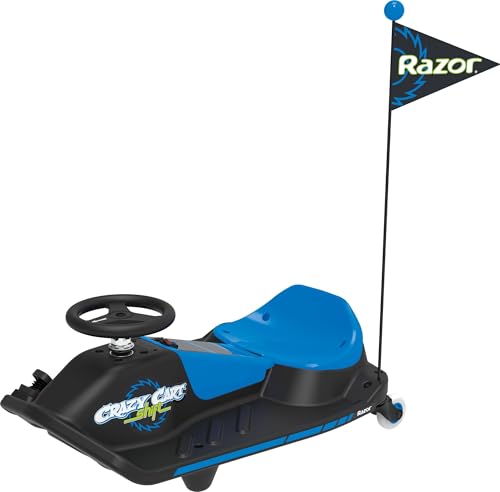
Ages 6+ drift kart with automatic rear drifts, 1:1 steering, up to 8 mph and up to 80 minutes per charge.
$148.00as of Oct 27, 2026 5:28 am EDT
Check price on AmazonWhy we like it
- Ages 6 and up, so 13 is in range
- About 22 lb, the lightest listed powered kart here
- Automatic drift system keeps both hands on the wheel
- Maintenance-free hub motor, no chain
| Specification | Details |
|---|---|
| Stated age range | 6 and up |
| Rider weight limit | not stated in listing |
| Top speed | Up to 8 mph, high/low switch |
| Motor and battery | 90W hub motor; 12V sealed lead-acid, up to 80 minutes |
| Steering | 1:1 ratio; fixed-incline rear casters |
Razor Crazy Cart Shift — ages 6+, 12V 90W hub motor, 8 mph, auto-drift casters, about 22 lb.
Light enough for a teen to carry
At roughly 22 lb, the Shift weighs less than any other powered kart on the shelf that lists its weight, so a 13-year-old can lift it into a car trunk or carry it to a tennis court alone. Its stated run time of up to 80 minutes is the longest on the shelf.
It is a toy-class drifter, not a go-kart in the racing sense. The 90W motor is the smallest here, and the listing gives no weight limit. Buy it for a teen who wants to spin and slide in a parking lot, not for one who wants to go fast.
Pros
- About 22 lb and easy to carry
- Up to 80 minutes per charge
- No chain to maintain
- Simple auto-drift controls
Cons
- No weight limit stated
- Smallest motor on the shelf
- 8 mph top speed
- Lead-acid battery
Check Razor Crazy Cart Shift price on Amazon
What to Look for in a Go-Kart for a 13-Year-Old
A 13-year-old is often the hardest kart buyer in the family. They are too big and too skilled for 5-mph toddler karts but too young for adult machines. The most common mistake is buying on speed alone. Start with these specs instead.
Stated age range first
The manufacturer’s age range is the clearest signal of who the kart was built for. Many kids’ karts on Amazon stop at 12, and many fast karts start at 14 or 16. Of the 12 listings we kept, 7 give a numeric range and 5 simply say youth. Where a listing says youth without numbers, ask the seller. If a kart is rated 14 and up, it was built for someone older, even if your 13-year-old is tall.
Weight limit with growth room
A typical 13-year-old is heading into a growth spurt. Take current weight, add about 30 lb, and treat that as the minimum rating. Only 4 of our 12 listings state a limit at all, so a missing number is common. An underrated kart will feel slow, wear its motor or clutch faster and stress the frame.
Speed with a rider aboard
Listed top speeds are usually measured under ideal conditions. A heavier rider, grass or a slope will cut that figure. For a first kart at 13, 8 to 15 mph on electric power is plenty on a driveway or lawn. Gas karts with a throttle limiter can start in that band and be opened up later. Our electric go-karts complete guide explains how voltage, motor watts and battery amp-hours combine.
Motor watts, voltage and engine cc
For electric karts, voltage sets the speed ceiling and watts set the pull under load. Two 300W motors on 24V will accelerate a teen better than a single 90W motor on 12V, even if both list similar top speeds. For gas karts, engine displacement (110cc, 125cc, 200cc to 212cc) tells you roughly how much power is available. Bigger is not better at 13 unless a speed limiter is fitted.
Brakes
Disc brakes, mechanical or hydraulic, are the step up from simple band or throttle-release braking. Five of our 12 listings mention a disc brake. On a gas kart, treat a disc brake as non-negotiable. On a light electric, a dedicated brake pedal or hand lever is the minimum.
Frame, seat and tires
Look for a steel frame, an adjustable seat or pedal box, and tires that suit your ground. Hard plastic drift wheels only work on smooth pavement. Pneumatic tires and suspension handle grass and dirt. Two-seat gas karts add a roll cage and harnesses, which matter on uneven land.
Safety Gear and Supervision at 13
A properly fitted helmet is mandatory at any speed. The American Academy of Pediatrics, via HealthyChildren.org, advises buying helmets that carry a safety-standard label and retiring any helmet after a serious crash. For gas karts and faster electrics, step up to a full-face motorsport or powersports helmet. Add gloves, closed shoes, long sleeves and eye protection.
Supervision should scale with speed. Use the lowest speed mode or throttle limiter for the first sessions, walk the riding area for holes and obstacles, and set a clear boundary. For off-road youth vehicles, the U.S. Consumer Product Safety Commission advises that riders under 16 use only age-appropriate youth models, never adult ones, and that riders wear a helmet and protective gear. That guidance is written for ATVs, but the principle carries over to youth gas karts: match the machine to the rider’s age.
If your teen is drawn to racing rather than backyard riding, look at an arrive-and-drive session at a local track first. Our kids kart racing guide covers junior classes and licensing, and our kids karting suit guide covers the extra gear organized racing requires.
Where a 13-Year-Old Can Ride Each Type
- Light electric and drift karts: Driveways, empty parking lots, tennis courts and smooth private pavement. Drift wheels need a hard, clean surface.
- Electric off-road karts with air tires: Lawns, packed dirt and gentle trails on private land.
- Youth gas karts: Private acreage, farm tracks and trails with permission. Noise and fumes make them a poor fit for small suburban yards.
None of these karts are road-legal. Public streets and sidewalks are off limits, and local rules on private-property riding and noise vary, so check before the first ride.
Maintenance Basics
Electric karts need a charging routine. Recharge after each ride, avoid running the battery flat, and top it up monthly during storage. Lead-acid batteries in particular lose capacity if left discharged. Check chain tension on chain-drive models and keep tires inflated on pneumatic ones.
Gas karts need fresh fuel, regular oil checks and a look at the chain, brakes and bolts before each session. Store fuel in an approved container away from living spaces. If a gas kart sits for a season, drain or stabilize the fuel to avoid a gummed carburetor.
Frequently Asked Questions
How fast should a go-kart for a 13-year-old be?
Is a 24V electric go-kart enough for a 13-year-old?
Should a 13-year-old get a gas or electric go-kart?
Can a 13-year-old drive a kart rated 14 and up?
What safety gear does a 13-year-old need for go-karting?
Can a 13-year-old race go-karts?
Final Thoughts
For a 13-year-old with room to ride, the HHH GK125 gives parents the most control on paper: a pedal limiter, a remote engine shut-off and hydraulic disc brakes. The TrailMaster Blazer 200R is the gas alternative with a stated 10-and-up range, and the Razor Ground Force Dune Runner is the pick for families who want quiet electric power with a disc brake, suspension and air tires. If you are also shopping for younger kids, our best go-karts for kids by age guide covers each age band.