
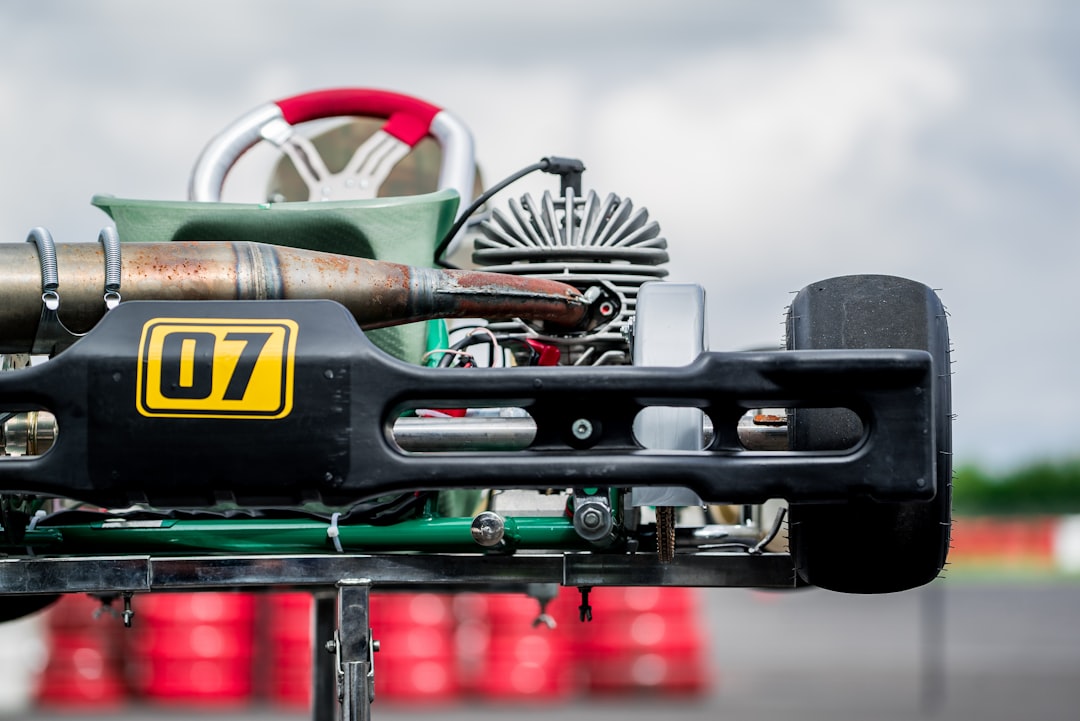
A front engine go kart places the engine ahead of the driver, near the front axle, and sends power back to a driven rear axle, usually through a long chain run and a jackshaft. Builders tried the layout in karting’s early years, and it survives today mainly in vintage restorations, replica builds, and novelty or hot-rod karts. Mainstream karting settled on rear and side engine placement because putting the weight over the driven rear tires improves traction and allows a short, simple chain drive. This guide explains how a front-engine layout works, how it changes handling, why the driveline is more complex, what a build costs, and when it still makes sense to build one.
Part of our Go-Kart Engines & Drivetrain guide — explore the full guide →
What Is a Front Engine Go Kart?
On a front engine go kart, the engine is mounted forward of the seat, between or just behind the front wheels. The driver sits behind it, much like a scaled-down front-engine race car. Because karts almost always drive the rear axle, power has to travel past the driver to reach the back of the kart.
When karting began in the late 1950s, there was no standard layout. Builders took ideas from midget racers, lawn equipment, and hot rods, and engines appeared in front, beside, and behind the driver. Front-engine designs lent some early karts a distinctive race-car look. Within a relatively short time, though, rear and side engines became the norm for racing and recreational karts alike.
A close relative is the quarter midget, a youth oval-racing car with a forward-mounted engine, a roll cage, and suspension. Quarter midgets are a separate racing category with their own rules and sanctioning bodies, but they keep the front-engine proportions mainstream karting moved away from.
For an overview of engine types and placements across the sport, see our go-kart engine guide.
How the Front Engine Layout Changes Handling
Weight distribution. A modern kart carries more of its weight on the rear axle than the front. Rear weight presses the driven tires into the track for grip under acceleration. This matters because most karts have a solid rear axle with no differential, and they rely on chassis flex and weight transfer to lift the inside rear tire through corners. Moving the engine to the front shifts a meaningful share of weight forward. Exact numbers depend on the engine, the frame, and where the driver sits, but the direction is predictable: heavier steering, stronger initial turn-in, and less traction at the rear when accelerating out of corners.
Cornering behavior. With less weight over the rear, a front-engine kart is more likely to spin its inside rear tire or push wide under power, and it tends to need a different driving style from a conventional kart. On straight-line or casual cruising builds this matters much less than on a twisty track.
Stability. Front-engine builds often have a longer wheelbase to fit the driveline, which can improve straight-line stability at the expense of agility.
The Front Engine Driveline: Jackshafts and Chain Runs
The driveline is the biggest practical cost of the layout. A rear-engine kart typically runs one short chain from the clutch to the axle sprocket. A front-engine kart has to carry power past the driver, which usually means:
A long chain run along one side of the kart, often beside the driver’s leg.
A jackshaft: an intermediate shaft with sprockets at each end, mounted in bearings. It breaks the drive into two shorter chain runs, corrects alignment, and lets you change the overall gear ratio. Our guide to go-kart jackshaft kits explains how they work and what to look for.
Extra bearings, idlers, and tensioners to keep long chains aligned and tight.
Full guarding along the entire chain run, especially wherever it passes near the driver.
Every extra sprocket, bearing, and length of chain adds friction, weight, and wear points. On the low-power engines common in yard karts, those losses are noticeable, and long chains need more frequent tension checks.
Front vs Rear vs Side Engine Compared
The table compares layouts in general terms. Exact weight distribution depends on the specific frame, engine, and driver position.
| Layout | Weight bias | Driveline | Handling character | Common use today |
|---|---|---|---|---|
| Front engine | Shifted toward the front | Long chain run, often a jackshaft and extra bearings | Sharp turn-in, weaker drive off corners | Vintage restorations, replicas, novelty builds |
| Side engine | Rear-biased, seat offset to balance | Short, direct chain | Balanced, responsive | Modern sprint racing karts |
| Rear engine | Rear-biased | Short, direct chain | Strong rear grip, predictable | Yard karts, rental karts, off-road karts |
Why Rear and Side Engines Won
Several factors made rear and side placement the standard. A short chain from engine to axle is lighter, cheaper, more efficient, and easier to guard than a long driveline running past the driver. Rear weight bias puts grip where a kart needs it, on the driven tires during acceleration. Side placement in sprint racing refined this further: the engine sits beside the driver, the seat is offset to balance the kart, and the chain stays short.
Today, vintage clubs and collectors are the main keepers of the front-engine tradition. Our guides to vintage go-kart brands and vintage go-kart racing cover the era and the events where older layouts still appear.
What a Front Engine Go Kart Costs
A front-engine build usually costs more than a comparable rear-engine kart because of the extra driveline parts and the longer custom frame. Typical USD ranges:
Engine: a common small horizontal-shaft engine typically costs $150 to $400.
Jackshaft kit, bearings, and sprockets: often $80 to $200.
Extra chain, idlers, and guards: commonly $50 to $150.
Frame: a custom or modified frame long enough for the layout, from a few hundred dollars in materials to considerably more if you pay for fabrication.
A home scratch build often lands somewhere between $800 and $1,800, depending on how much welding and fabrication you do yourself. Vintage restorations are a separate market: prices for original front-engine karts range from inexpensive project karts to collector-level sums for complete, correct examples. Much of the cost and effort goes into finding period-correct parts through swap meets and vintage clubs.
When a Front Engine Build Makes Sense
Vintage restoration or tribute. If you’re restoring a period kart or building a faithful replica, the layout is the point.
Midget-style look. For a kart that resembles a classic midget racer, with the engine under a nose cowl and the driver behind it, front placement is the natural choice.
Engineering project. Designing a jackshaft driveline, balancing weight distribution, and building custom frame geometry makes a rewarding, educational project for a school shop or ambitious home builder.
Style builds. Hot-rod karts and miniature racer replicas often put the engine up front purely for the silhouette.
For a first kart, build a conventional rear-engine layout. It’s simpler, cheaper, safer to guard, and handles better. Our how to build a go-kart guide walks through the standard approach, and a used go-kart frame can be a cost-effective starting point for either style.
Safety and Maintenance
The long driveline is the main safety concern. Guard every chain and sprocket along its full length, especially where it runs near the driver’s legs and hands. Route the throttle and brake cables, steering linkage, and fuel line clear of the chain. Keep the exhaust and hot engine parts away from the driver’s feet. With the fuel tank often near the engine, use a proper tank mount and keep lines away from heat.
Fit a reliable rear brake, a kill switch within reach, and wear a helmet and protective clothing as you would in any kart. Check chain tension and jackshaft bearings before each session, because long chains stretch and loosen faster than short ones. Lubricate chains regularly, and inspect sprockets for hooked teeth.
Pros and Cons
The front-engine layout trades everyday practicality for character.
Pros
- Authentic vintage and midget-racer look
- Engine heat and noise stay ahead of the driver
- Easy access to the engine for maintenance
- Longer wheelbase can improve straight-line stability
- Rewarding engineering challenge for builders
Cons
- Forward weight bias reduces rear traction and drive off corners
- Jackshaft driveline adds cost, friction, and wear points
- Long chain runs near the driver need careful guarding
- Rarely a fit for mainstream kart racing classes
Frequently Asked Questions
Why do go-karts have the engine in the back?
What is a jackshaft on a go-kart?
Are quarter midgets the same as front-engine go-karts?
Do front-engine go-karts handle worse?
How much does it cost to build a front-engine go-kart?
Can I convert a rear-engine kart to front-engine?
Final Thoughts
The front engine go kart lost the engineering argument long ago, but it never lost its charm. If you’re restoring a vintage machine, chasing a midget-racer look, or simply want a build that stands out, the layout offers character a modern kart can’t. Plan the jackshaft driveline carefully, guard every chain run, accept the front-heavy handling, and enjoy building a piece of karting history.