
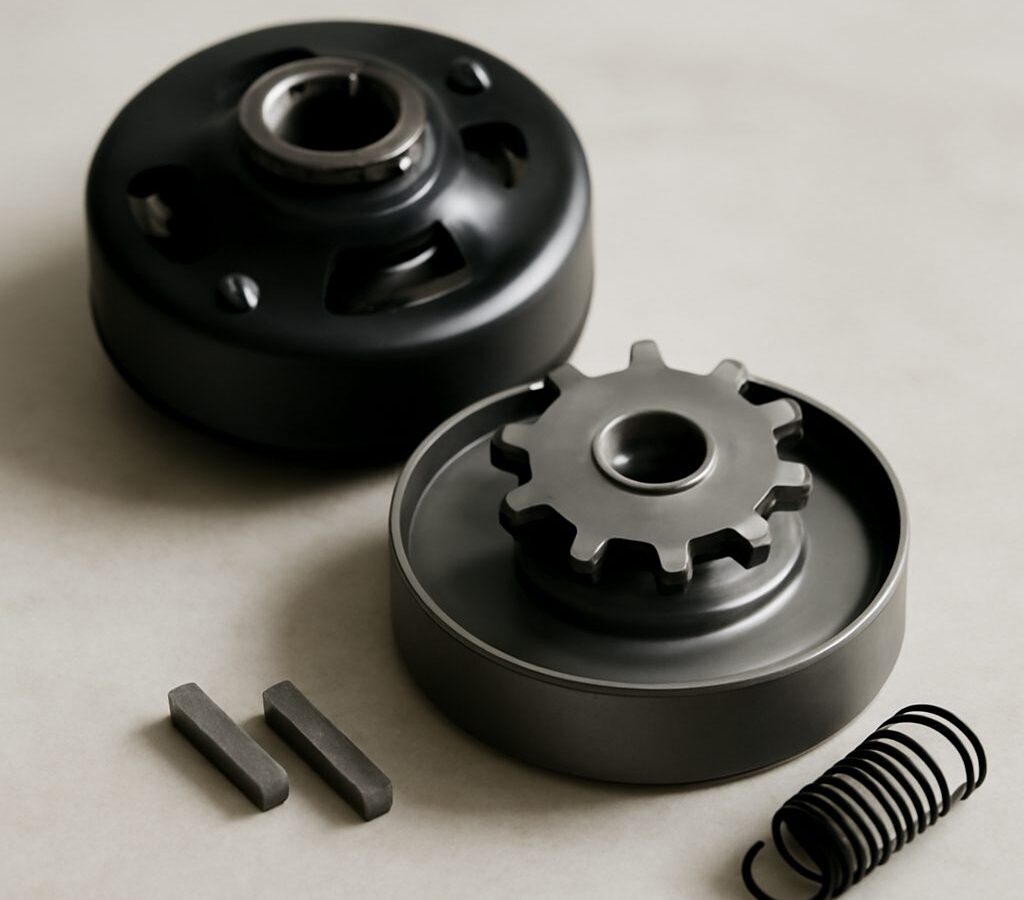
A go kart clutch kit is a matched set of drivetrain parts that connects your engine to the rear axle: at minimum a clutch for the crankshaft, and usually a chain, an axle sprocket, a key, and mounting hardware. Buying a kit instead of loose parts saves you from the most common mistake, which is mixing a clutch, chain, and sprocket that do not share the same chain pitch. To choose one, you need four facts: your crankshaft diameter, your engine’s power, the chain size you want to run, and how heavy the kart and driver will be. This guide explains what kits contain, the main kit types, how to match one to your build, and how to install and maintain it.
Part of our Go-Kart Engines & Drivetrain guide — explore the full guide →
What Is in a Go-Kart Clutch Kit?
Contents vary by seller, so read the parts list rather than assuming. A typical centrifugal clutch kit includes:
- The clutch, with a bore sized to a specific crankshaft and a built-in drive sprocket.
- A chain in the matching pitch, usually long enough to cut to length.
- An axle sprocket, sometimes with a hub, in the same pitch.
- A key, bolt, and washer to secure the clutch on the crankshaft.
- Sometimes a master link, a chain guard, or spacers.
Torque converter kits are different. They usually include a driver pulley for the crankshaft, a driven pulley, a belt, a jackshaft or bracket, a cover, and the sprocket that drives the chain. Some also include a chain and axle sprocket; others assume you already have them.
Missing pieces are a common source of frustration. If the kit lacks an axle sprocket hub sized to your axle, or the chain is too short for your wheelbase and engine position, you will be ordering parts again. Check axle diameter, sprocket bolt pattern, and chain length before you buy.
Types of Go-Kart Clutch Kits
Most recreational and DIY builds use one of three designs.
Centrifugal clutch kits are the simplest and cheapest. Spring-loaded shoes fly outward as RPM rises and lock against a drum. They suit light karts on flat ground with small engines. Because the ratio is fixed, they slip and heat up under heavy load or on hills. Our centrifugal clutch guide explains the mechanism and sizing in detail.
Torque converter kits use a belt between two variable-diameter pulleys. At low speed they give a low ratio for strong pulling; as speed rises, the ratio shifts taller. They suit heavier drivers, two-seaters, larger engines, and off-road use, at the cost of more space, weight, and money. See our go-kart torque converter guide for series sizes and fitment.
Heavy-duty and racing clutch kits range from multi-disc dry clutches for modified engines to oil-bath wet clutches on some racing engines. They offer tunable engagement and better heat handling, but they cost more and need more setup knowledge. Most yard-kart builders do not need them.
Best Predator 212 Clutch and Torque Converter: our top 3 picks
| Product | Best for | Key features | Price | Buy |
|---|---|---|---|---|
| Youxmoto 30 Series Torque Converter | Best overall |
| $56.99as of Oct 27, 2026 6:39 am EDT | Buy now →Check current price |
| ILONPA 10T Centrifugal Clutch | Best centrifugal clutch |
| $25.99as of Oct 27, 2026 6:39 am EDT | Buy now →Check current price |
| GYMMEDS 30 Series Torque Converter | Best for mixed hardware threads |
| $58.66as of Oct 27, 2026 6:39 am EDT | Buy now →Check current price |


Prices are Amazon’s listed prices as of the date and time shown and are subject to change; the price on Amazon at the time of purchase applies. As an Amazon Associate we earn from qualifying purchases.
See every pick compared: Best Predator 212 Clutch and Torque Converter →
Go-Kart Clutch Kit Types Compared
Price ranges below are typical USD figures for complete kits and vary by brand, contents, and engine size.
| Kit type | Typical cost | Low-speed pulling | Heat under load | Best for |
|---|---|---|---|---|
| Basic centrifugal | $30–$80 | Fixed ratio, none added | High if gearing is tall | Light karts, flat ground, stock small engines |
| Heavy-duty centrifugal | $70–$180 | Fixed ratio, none added | Moderate; more friction area | Modified engines, heavier single-seat karts |
| Torque converter (CVT) | $90–$300 | Strong, variable ratio | Low at the clutch; belt wears instead | Hills, off-road, two-seaters, adult drivers |
| Racing or wet clutch | $150 and up | Fixed ratio, tunable engagement | Low when set up correctly | Competition and high-output engines |
How to Choose a Go Kart Clutch Kit
Work through these checks in order. Each one rules out a large share of the options.
1. Crankshaft size. The clutch or driver pulley bore must match your crank exactly, keyway included. Most 196cc to 224cc clone engines use a 3/4 inch shaft. Many 420cc-class engines use 1 inch. Some small engines use 5/8 inch. Measure it or check the engine manual.
2. Engine output. Clutches and converters are rated for a power range. A unit rated below your engine’s output will slip and wear quickly. If you plan to modify the engine later, buy for the future output rather than the stock figure.
3. Chain pitch. #35 chain is common on light karts with small engines. #40, #41, and #420 chain handle more load and are common on heavier builds and larger engines. The clutch sprocket, chain, and axle sprocket must all share the same pitch. #40 and #41 share a pitch but differ in strength, and #420 is a motorcycle-style chain; check that your sprockets are rated for the chain you choose.
4. Load and terrain. A light kid or adult on flat pavement is well served by a centrifugal kit. An adult on grass, a passenger seat, sand, or real hills strongly favors a torque converter.
5. Gearing. The kit’s sprocket sizes set your overall ratio. Fewer teeth on the clutch or more on the axle gives quicker acceleration and less clutch slip but lower top speed. Use a go-kart sprocket calculator to estimate speed from your tire size and engine RPM before you order.
6. Fitment space. Torque converters are wider than clutches. Confirm the frame has room, that the driven pulley will sit where the chain can reach the axle in a straight line, and that a cover can be fitted.
For specific models that suit the most common clone engine, see our best Predator 212 clutch roundup. For a broader look at engine choices that drive this decision, visit our go-kart engine hub.
Installation Steps
Installing a centrifugal clutch kit is beginner-friendly but detail-sensitive. A typical sequence:
- Disconnect the spark plug wire so the engine cannot start.
- Clean the crankshaft, fit the key, and slide the clutch on in the orientation shown in the instructions.
- Secure it with the supplied bolt and washer, using the torque value and thread locker the maker recommends.
- Mount the axle sprocket and align it with the clutch sprocket using a straightedge across both faces.
- Cut the chain to length, fit the master link with the clip’s closed end facing the direction of travel, and set tension by sliding the engine on its mount.
- Fit the chain guard, reconnect the plug wire, and test at low speed before driving hard.
Leave a small amount of free play in the chain, commonly around 1/4 to 1/2 inch at the midpoint. Bar-tight chains load the crank bearing and clutch bushing; loose chains can jump off. For chain selection and sizing, see our go-kart clutch chain guide.
Torque converter installs take longer because the driven pulley usually sits on a jackshaft or bracket, and belt alignment between the pulleys must be accurate. Follow the kit instructions closely, and recheck alignment after the first run.
Maintenance
Centrifugal kits: if the clutch has an oil-lubricated bushing, oil it at the interval the maker recommends, and never put oil on the shoes or inside the drum. Check chain tension and alignment every few hours. Inspect the drum for blue discoloration, which points to overheating from slip.
Torque converter kits: keep the pulleys clean and dry, inspect the belt for cracks, glazing, and fraying, and replace it before it fails. Do not lubricate the belt faces.
Both: clean and lubricate the chain, replace worn sprockets with hooked teeth, and listen for new noises. A burning smell, slipping, or a kart that creeps at idle means something needs attention now rather than later.
Safety Notes
Every chain drive and clutch needs a guard. Spinning clutches, belts, and chains can catch loose clothing, long hair, and fingers in an instant. Keep hands away from the drivetrain when the engine is running, even at idle, because a sticking clutch or high idle can engage without warning. Make sure your brakes can hold the kart against the engine at full idle, and fit a kill switch the driver can reach.
Pros and Cons of Buying a Clutch Kit
Pros
- Matched pitch across clutch, chain, and sprocket avoids fitment errors
- Usually cheaper than buying each part separately
- Torque converter kits transform hill climbing and heavy-load pulling
- Most kits bolt on with basic hand tools
Cons
- Kit contents vary and may omit hubs, guards, or enough chain
- Centrifugal kits slip and overheat under heavy load
- Torque converter kits cost more and need more frame space
- Shoes, belts, chains, and sprockets are all wear items
Frequently Asked Questions
What comes in a go-kart clutch kit?
What is the difference between a centrifugal clutch kit and a torque converter kit?
Which clutch kit is best for hills?
How do I know what bore and chain size to buy?
Can I install a clutch kit myself?
Why is my new clutch slipping or smelling hot?
Final Thoughts
The right clutch kit is the one that matches your crankshaft, your engine’s output, your chain pitch, and the job the kart has to do. Choose a centrifugal kit for light, flat-ground builds and a torque converter for weight, passengers, and hills. Read the parts list before ordering, align everything with a straightedge, and guard the drivetrain. Get those basics right and the kit will be one of the most reliable parts on the kart.