

A go kart engine with transmission combines the motor and a gearbox, or a variable drive, in one package, so the kart can pull hard from a standstill and still reach a useful top speed. Most basic karts use a single-speed clutch, which limits both acceleration and speed. Choosing an engine that already has a transmission built in, or adding one, changes how the kart drives. This guide explains the main options, from shifter engines and motorcycle or ATV powerplants to belt-drive units and reverse gearboxes, with typical USD costs, fitment tips, and the trade-offs in weight, complexity and maintenance.
Part of our Go-Kart Engines & Drivetrain guide — explore the full guide →
What Is a Go Kart Engine with Transmission?
A transmission lets the engine run at a useful speed across a wider range of road speeds. Without one, a kart has a single fixed gear ratio between the engine and the axle. Choose a low ratio and the kart accelerates hard but runs out of revs quickly; choose a tall ratio and top speed rises but the kart struggles away from a stop.
When people search for an engine with transmission, they usually mean one of three setups:
- Integrated gearbox engines: the gearbox sits inside the engine cases, as on shifter kart engines and motorcycle or ATV engines.
- Engines paired with a CVT: a belt-driven variable drive such as a torque converter, or an integrated scooter-style CVT.
- Engines paired with a separate gearbox or transaxle: a standalone transmission between the engine and axle, sometimes with reverse.
For the basics of kart engines without gearboxes, see our main go-kart engine guide.
Types of Engine and Transmission Setups
Shifter kart engines. Purpose-built two-stroke racing engines, commonly 125cc, with an integrated sequential gearbox, typically six speeds. Used on sprint tracks in shifter classes. Light, very powerful and demanding to maintain. Our guide to shifter kart engines covers them in depth.
Motorcycle and ATV engines. Engines taken from dirt bikes, road bikes, ATVs and pit bikes include their own gearbox and clutch. They are popular for off-road karts, buggies and high-performance DIY builds. Some ATV engines include reverse, which is useful for heavy karts. See our guide to go-karts with motorcycle engines for build details.
Scooter-style CVT engines. Many Chinese buggies and recreational karts use engines in the 150cc range with an integrated belt CVT. They are fully automatic, easy to drive and relatively cheap. Some come with a separate reverse box.
Small engine plus torque converter. A common upgrade for yard karts with small single-cylinder engines. The torque converter acts as an automatic variable transmission. It bolts on externally and needs a jackshaft.
Small engine plus forward-reverse gearbox. Some heavy recreational karts pair a single-speed or CVT engine with a separate gearbox that adds reverse. Our guide to the 3 speed transmission with reverse explains these units.
Best Go Kart Engine: our top 3 picks
| Product | Best for | Key features | Price | Buy |
|---|---|---|---|---|
| maXpeedingrods MXR212R | Best overall 212cc |
| $149.99as of Oct 25, 2026 3:46 am EDT | Buy now →Check current price |
| maXpeedingrods MXR212E | Best electric start |
| $209.99as of Oct 25, 2026 3:46 am EDT | Buy now →Check current price |
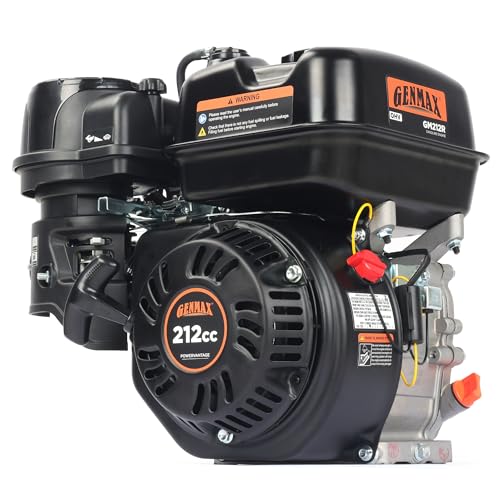
| GENMAX GM212R | Best support plan |
| $169.99as of Oct 25, 2026 3:46 am EDT | Buy now →Check current price |


Prices are Amazon’s listed prices as of the date and time shown and are subject to change; the price on Amazon at the time of purchase applies. As an Amazon Associate we earn from qualifying purchases.
Engine and Transmission Options Compared
| Setup | Shifting | Reverse | Typical Use | Maintenance |
|---|---|---|---|---|
| Shifter kart engine | Manual sequential | No | Sprint racing | High |
| Motorcycle engine | Manual sequential | Rarely | High-performance DIY and off-road | Moderate |
| ATV engine | Manual or semi-automatic | Often | Off-road and heavy karts | Moderate |
| Integrated CVT engine | Automatic | With add-on box | Buggies and recreational karts | Low to moderate |
| Small engine plus torque converter | Automatic | No | Yard karts and minibikes | Low |
Cost of a Go Kart Engine with Transmission
Costs vary hugely by setup, condition and source. Typical USD ranges:
- Small engine plus torque converter kit: roughly $250 to $600 combined.
- New 150cc-class engine with integrated CVT: roughly $300 to $700.
- Used motorcycle or ATV engine with gearbox: roughly $300 to $1,500 depending on size and condition.
- New shifter kart engine: often several thousand dollars; used examples vary widely with hours and rebuild history.
- Separate forward-reverse gearbox: roughly $150 to $500.
Budget for the extras too: mounts, a matched chain and sprockets, throttle and shift linkages, wiring, a fuel tank and possibly a larger axle and stronger brakes. These extras can add a significant share to the engine price, so price the whole drivetrain before committing.
How to Choose the Right Engine and Transmission
Match it to how you drive. Racing on a sprint track points toward shifter engines. Trail riding and heavy karts favor ATV engines or CVTs. Casual yard use is well served by a small engine with a torque converter.
Consider the driver. Manual gearboxes require skill with a clutch and shifting. For kids and new drivers, an automatic CVT is easier and safer.
Check weight and frame fit. Motorcycle and ATV engines are heavier and larger than small kart engines. The frame and engine mount must be strong enough, and the chassis needs room for the engine, exhaust and linkages.
Plan the controls. A manual gearbox needs a shift lever or paddle linkage and often a hand clutch. A CVT needs only a throttle. Reverse needs a selector.
Think about brakes and safety. More power and speed demand stronger brakes, a sturdier frame and better protective gear. A roll cage is wise on fast off-road builds.
Fitting an Engine with a Built-In Gearbox
Installing a motorcycle or ATV engine is a bigger job than bolting on a small kart engine. The general steps are:
- Fabricate or buy engine mounts that hold the engine securely at its original mounting points.
- Align the gearbox output sprocket with the axle sprocket so the chain runs straight.
- Set up the throttle cable, clutch cable or lever, and shift linkage.
- Wire the ignition, kill switch, charging system and starter if used.
- Route the exhaust away from the driver, fuel tank and wiring.
- Fit a chain guard and test everything at low speed before driving hard.
Many builders choose a chassis or frame kit designed for the engine they plan to use, which saves fabrication. Our how to build a go-kart guide covers frames, mounts and wiring basics.
Maintenance Considerations
An integrated gearbox shares or uses its own oil, which must be changed at the interval the manufacturer specifies. Shifter engines need frequent top-end rebuilds in racing use. CVT belts, rollers and clutches are wear items. Torque converter belts wear and must be replaced periodically. Whatever the setup, check chain tension and alignment, the clutch adjustment and the shift linkage before each ride.
Common Mistakes to Avoid
Ignoring final drive gearing. A gearbox does not remove the need to choose the right sprockets. A motorcycle engine geared for road speeds can leave a kart with a uselessly tall first gear. Calculate the overall ratio in first and top gear, then pick sprockets that suit your track or trail.
Underestimating weight. Motorcycle and ATV engines often weigh far more than a small kart engine. That extra mass changes the balance of the kart, loads the rear axle and bearings, and lengthens braking distances.
Skipping the cooling check. Engines designed for motorcycles rely on airflow at speed or on a radiator. Mounted low and behind a seat, they can run hot. Liquid-cooled engines need a radiator positioned to receive clean air.
Poor linkage design. Sloppy shift linkages cause missed gears and damage gearboxes. Use rod ends, keep linkages short and stiff, and make sure nothing binds when the steering is turned.
Buying an engine without history. Used engines with gearboxes can hide worn gear dogs, a slipping clutch or low compression. Ask to see the engine run, shift through every gear and check the oil for metal particles before you buy.
Is a Transmission Worth It?
A transmission makes the most sense when the kart is heavy, the terrain varies, the engine has a narrow power band, or you want reverse. For a light kart on flat ground with a small engine, a single-speed clutch is lighter, cheaper and easier to maintain, and it may be all you need. If you are torn between the two, consider how often the kart will be driven slowly, carry passengers or tackle hills. Those situations are where a transmission pays off.
Pros and Cons
An engine with a transmission widens what a kart can do, but it adds weight and complexity.
Pros
- Strong acceleration and good top speed from one engine
- Better hill climbing and low-speed control
- Reverse available on many ATV and add-on setups
- Shifter engines deliver serious racing performance
Cons
- Heavier and more complex than a single-speed setup
- Manual gearboxes require driving skill
- More maintenance and more parts to wear
- Larger engines need stronger frames and brakes
Frequently Asked Questions
What is the easiest go-kart engine with a transmission?
Can I use a dirt bike engine in a go-kart?
Do go-karts with gearboxes have reverse?
Is a torque converter a transmission?
How fast is a go-kart with a transmission?
Is a shifter kart engine good for a backyard kart?
Final Thoughts
A go kart engine with transmission can turn a simple kart into a far more versatile machine, whether that means a shifter on a race track, an ATV engine in a trail buggy or a torque converter on a yard kart. Match the setup to the driver, the terrain and the frame, and budget for mounts, controls and stronger brakes. For a comparison of drive types, read torque converter vs clutch next.