
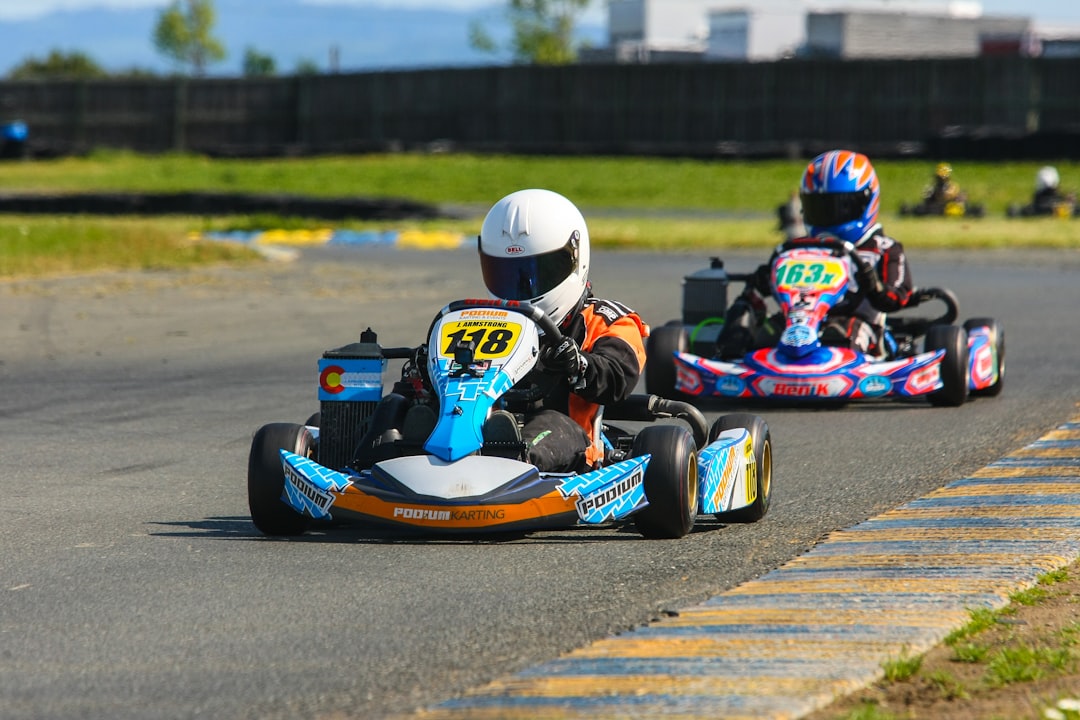
The right go kart tire sizes depend first on your rim diameter, then on the kind of kart you run. Sprint racing karts almost all use 5-inch rims, typically with a 10-inch-tall front tire around 4.5 inches wide and an 11-inch-tall rear around 6 to 7 inches wide. Yard and recreational karts usually run 6-inch or 8-inch rims with taller turf or knobby tires, and off-road buggies step up to 10-inch rims and beyond. This guide works as a size finder: it shows which sizes each type of kart normally uses, how to pair fronts and rears, and what happens when you change size. For a deeper look at reading sidewall codes and measuring a tire, see our companion guide to go-kart tire dimensions.
Part of our Go-Kart Parts guide — explore the full guide →
Go-Kart Tire Sizes in One Minute
Every kart tire size tells you three things: how tall the tire is, how wide it is, and what rim diameter it mounts on. The rim diameter is always the last number. A tire that ends in -5 fits a 5-inch wheel, -6 fits a 6-inch wheel, and so on. Nothing else about the size matters if that last number is wrong.
You will see sizes written two main ways. Recreational tires usually put height first, as in 11×6.00-5 (11 inches tall, 6 inches wide, 5-inch rim). Racing tires are often printed width first, as in 7.10/11.0-5, which describes essentially the same kind of tire as 11×7.10-5. Metric sizes such as 145/70-6 give width in millimeters and the sidewall height as a percentage of that width.
There is also a third format, common on wheelbarrow and small utility tires, such as 4.10/3.50-5. That code does not describe height at all. The two numbers before the dash are alternative width ratings, so the tire is roughly 3.5 to 4.1 inches wide, and you need the manufacturer’s spec sheet to learn its actual diameter. If a code confuses you, our tire dimensions guide walks through every marking on the sidewall.
Common Go-Kart Tire Sizes by Kart Type
The fastest way to narrow your search is to start from the kind of kart you own. Within each category, sizes are fairly standardized because frames, axles, and brakes are designed around them.
Sprint and Racing Karts
Modern sprint karts use 5-inch rims almost universally. The typical dry slick pairing is a 10×4.50-5 front and an 11×7.10-5 rear, sometimes listed as 4.50/10.0-5 and 7.10/11.0-5. Some classes and older chassis use a narrower 11×6.00-5 rear. Wet-weather tires are usually close to the same sizes but with a grooved tread and different compound.
In racing, the size is rarely your choice. Most classes specify an exact tire model, compound, and sometimes size, and junior or cadet classes may use narrower tires than seniors. Always check your class rules before ordering. Our guide to racing go-kart tires covers compounds and how racers manage tire wear.
Yard and Recreational Karts
Backyard karts and off-the-shelf recreational models mostly run 6-inch or 8-inch rims. Common sizes include 13×5.00-6 and 145/70-6 on smaller karts and minibike-style builds, and 15×6.00-6, 16×6.50-8, 18×9.50-8, and 19×7.00-8 on full-size yard karts. Front tires are typically narrower than rears, and many karts use the same diameter front and rear so the frame sits level.
Off-Road Karts and Buggies
Larger off-road karts and buggies usually move to 8-inch, 10-inch, or 12-inch rims with tall knobby tires. Sizes in the 19×7-8, 21×7-10, and 22×10-10 range are common on mid-size machines, with wider rears than fronts. These are ATV-style sizes, and they share a large aftermarket with small ATVs and UTVs. For tread options, see our guide to off-road kart tires.
Kids Karts
Kids karts span everything from 5-inch racing slicks on cadet chassis to small 4-inch and 6-inch turf tires on entry-level backyard models. The key is to buy replacements in the exact size printed on the existing sidewall, since kids karts have tight fender and frame clearances.
Best Go Kart Tires: our top 3 picks
| Product | Best for | Key features | Price | Buy |
|---|---|---|---|---|
| SunF K001 11x7.10-5 slick | Best overall rear slick |
| $77.98as of Oct 27, 2026 5:47 am EDT | Buy now →Check current price |
| SunF K001 10x4.5 front set | Best front slicks |
| $134.96as of Oct 27, 2026 5:47 am EDT | Buy now →Check current price |
| Kemblawolf 5 in wheel set | Best complete 5-inch set |
| $389.89as of Oct 27, 2026 5:47 am EDT | Buy now →Check current price |


Prices are Amazon’s listed prices as of the date and time shown and are subject to change; the price on Amazon at the time of purchase applies. As an Amazon Associate we earn from qualifying purchases.
Go-Kart Tire Size Chart
Use this chart as a starting point, then confirm against the size molded into your current tires. Heights and widths are nominal and vary a little between brands.
| Tire size | Rim | Approx. height x width | Typical use | Common tread |
|---|---|---|---|---|
| 10×4.50-5 (4.50/10.0-5) | 5 in | 10 x 4.5 in | Sprint kart front | Slick or rain |
| 11×7.10-5 (7.10/11.0-5) | 5 in | 11 x 7.1 in | Sprint kart rear | Slick or rain |
| 11×6.00-5 | 5 in | 11 x 6 in | Narrow-rear classes, rec karts | Slick |
| 13×5.00-6 | 6 in | 13 x 5 in | Small yard karts, fronts | Turf, knobby |
| 145/70-6 | 6 in | About 14 x 5.7 in | Minibike-style karts | Knobby, street |
| 16×6.50-8 | 8 in | 16 x 6.5 in | Yard karts | Turf, knobby |
| 18×9.50-8 | 8 in | 18 x 9.5 in | Yard kart rears | Turf, knobby |
| 21×7-10 / 22×10-10 | 10 in | 21-22 in tall | Off-road karts, buggies | Knobby |
Matching Front and Rear Sizes
Most karts run different tires front and rear, and that is by design. The rear tires sit on the driven axle, so they get extra width for traction under power. The fronts handle steering, so a narrower tire keeps steering effort low and the kart responsive.
Diameter matters as much as width. On a yard kart, keeping front and rear diameters similar keeps the frame level and the seating position as designed. On racing karts, the slightly taller rear is part of the chassis geometry, and the manufacturer has set up the frame around it. Changing either end shifts ride height, weight transfer, and handling.
Always run the same size on both sides of an axle. A mismatched pair causes the kart to pull, and on a solid rear axle, which most karts use, uneven rear diameters scrub and wear tires quickly.
How to Choose Go-Kart Tire Sizes for Your Kart
Work through these steps in order and the choice becomes simple.
1. Confirm rim diameter. Read the last number on your current tire, or measure the wheel bead seat. This eliminates most of the market immediately.
2. Check rim width. A tire needs a rim close to its design width to seat its bead and hold its shape. Tire makers list an approved rim width range for each size, and a very wide tire on a narrow rim balloons and squirms.
3. Measure clearance. Check the space between the tire and the frame, fenders, bodywork, brake components, and chain at full steering lock. Taller or wider tires that rub are a safety problem, not a cosmetic one.
4. Match tread to surface. Slicks for clean pavement, ribbed or street tread for driveways and parking lots, turf tread for grass, and knobbies for loose dirt and trails.
5. Check the rules. If you race, the class rules decide the tire, and often the size too. Recreational owners have more freedom but should still respect the load and pressure ratings on the sidewall.
When you are ready to compare specific products, our roundup of the best go-kart tires groups options by kart type and surface.
What Changing Tire Size Does
Going up or down a size is a common upgrade, but it changes more than looks.
Gearing. A taller tire covers more ground per axle turn, which acts like taller gearing: higher potential top speed but slower acceleration, and more load on a small engine or clutch. A shorter tire does the opposite. You can often compensate by changing sprocket sizes. A go-kart speedometer shows what a tire change really does to your speed.
Ground clearance and center of gravity. Taller tires lift the frame, which helps on rough ground but raises the center of gravity and the rollover risk in hard corners. Lower setups feel more planted on pavement.
Steering and braking. Wider front tires add steering effort and can rub at full lock. Larger, heavier tires also take more braking force to stop, so make sure the brakes are up to it.
Rims and hubs. Moving to a different rim diameter means new wheels, and possibly new hubs, bearings, or spacers. Plan the whole wheel package, not just the tire. Our guide to go-kart wheels explains bolt patterns and hub types.
Typical Costs by Size
Prices vary widely by brand and compound, so treat these as typical USD ranges rather than quotes.
Small turf and knobby tires for 6-inch and 8-inch rims commonly cost about $20 to $60 each. Larger off-road tires on 10-inch and 12-inch rims typically run $40 to $120 each. Racing slicks are usually sold as sets, and a set of four commonly falls somewhere around $180 to $350 depending on compound and class, with rain tires in a similar band. Mounted wheel-and-tire assemblies cost more but save you the mounting work.
Racing tires are consumables. Soft compounds may only last a few race days at peak grip, while hard recreational tires can last years of casual riding. Budget accordingly, and see how much a go-kart costs for the bigger ownership picture.
Tire Pressure, Safety, and Care
Correct pressure matters as much as correct size. Never exceed the maximum pressure printed on the sidewall, including when seating beads. Recreational karts often run somewhere around 10 to 20 psi, while racing slicks are typically run at lower pressures that racers fine-tune by track temperature and conditions. Check the tire maker’s recommendation as your starting point.
Inspect tires before each session for cuts, cracks, flat spots, and exposed cords. Old tires harden with age even when the tread looks fine, which cuts grip. Store spare tires out of sunlight and away from heat. When it is time to swap rubber, our guide on how to change go-kart tires covers bead breaking and mounting without damaging the rim.
Pros and Cons of Standard Kart Tire Sizes
Standardized sizing makes kart tires easy to shop for, but it has limits worth knowing.
Pros
- The rim diameter in every size code makes fitment checks quick
- Standard sprint sizes mean wide choice for racing karts
- Yard and off-road sizes share parts with lawn equipment and ATVs
- Changing size is an easy way to tune gearing and clearance
Cons
- Several naming formats confuse first-time buyers
- Bigger tires can rub, overload small engines, or raise rollover risk
- Race classes often lock you into one tire and size
- Nominal sizes vary slightly between brands
Frequently Asked Questions
What size tires do racing go-karts use?
What size tires are on a typical yard kart?
Can I put bigger tires on my go-kart?
Is 11x7.10-5 the same as 7.10/11.0-5?
Do front and rear go-kart tires need to be the same size?
How do I find my go-kart tire size?
Final Thoughts
Choosing go kart tire sizes is mostly a process of elimination. Lock in your rim diameter, match the size family to your kart type, keep left and right identical, and confirm clearance before you buy. Racers should let the class rules lead, while recreational owners can tune gearing and clearance with a careful size change. For more parts guidance, browse our go-kart parts hub.