
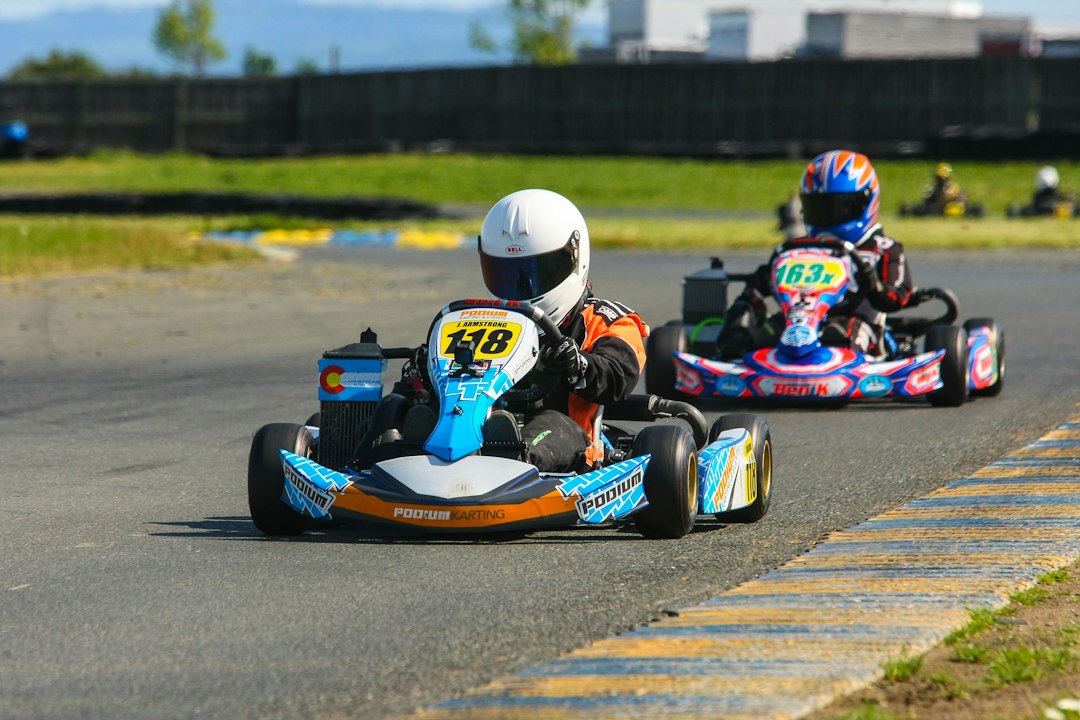
Kart understeer and oversteer are the two basic ways a kart can lose balance in a corner. Understeer means the front tires run out of grip first and the kart pushes wide. Oversteer means the rear tires let go first and the back steps out. Every handling complaint a driver brings to the pits is some version of one of these, at some point in the corner. This guide explains what each one feels like, how to tell whether the cause is driving or setup, which adjustments commonly help, and how to give feedback that leads to the right fix. Setup changes are described as tendencies to test, not guaranteed cures.
Part of our Kart Racing guide — explore the full guide →
What Are Understeer and Oversteer?
Understeer, often called push, happens when the front tires cannot generate the cornering force you are asking for. You turn the wheel and the kart carries on wider than intended. Adding more steering usually makes it worse, because the front tires are already beyond their limit and start to scrub.
Oversteer, often called loose, happens when the rear tires lose grip before the fronts. The rear slides outward, the kart rotates more than you asked for and you need opposite lock, or a lift, to catch it.
Karts add a twist. Because the rear axle is solid, the kart relies on the inside rear tire lifting or unloading to turn. If the inside rear stays planted, the axle binds and the kart pushes in a way that feels like understeer but is really a rear-end problem. That is why kart setup advice sometimes sounds backwards compared with car setup.
Diagnosing Kart Understeer and Oversteer by Corner Phase
The most useful thing you can do is say where in the corner the problem happens. The same symptom has different causes on entry, mid-corner and exit.
Entry. Understeer on entry often comes from braking too late or still braking hard while turning, overloading the fronts. Oversteer on entry often comes from braking that locks or unsettles the rear, or from turning in too sharply on a light rear.
Mid-corner. Mid-corner push is often a setup balance issue or a sign the inside rear is not lifting. Mid-corner looseness may point to too little rear grip for the conditions.
Exit. Understeer on exit can come from getting on the throttle too early with steering still applied, or from a kart that bogs because the rear has too much grip. Exit oversteer usually means the rear cannot handle the power and steering combined, or the throttle is being applied too abruptly.
Our guide to the karting racing line is worth reviewing alongside this, because a poor line often creates handling symptoms that look like setup problems.
Driving Causes Versus Setup Causes
Before changing the kart, rule out the driver. Common driving causes include:
- carrying too much speed into the corner, which overloads the front tires,
- turning the wheel too quickly or too far, which scrubs the fronts,
- braking too hard while turning, which can either push or snap the rear,
- applying throttle abruptly with lots of steering lock, which breaks the rear loose,
- a line that asks the kart to turn sharply at the slowest point.
A good check is consistency. If the problem appears every lap in the same place regardless of small changes in technique, setup is more likely. If it comes and goes, driving is more likely. Watching onboard video or comparing a data trace with a faster driver also helps; a good data logger makes the comparison easy. For braking-related symptoms, read our kart braking technique guide.
Common Setup Fixes Compared
Once you are confident setup is the issue, these are the adjustments most often tried. Each one is a tendency that depends on your chassis, tires and track, so start from your manufacturer’s setup sheet and change one thing at a time.
| Adjustment | Often tried for understeer | Often tried for oversteer | Notes |
|---|---|---|---|
| Front track width | Widen to increase front leverage | Narrow to calm the front | Effect size varies by chassis |
| Rear track width | Widen to free the rear if axle binds | Narrow to add rear grip | Common first adjustment for rear grip |
| Caster | Add to increase jacking and inside rear lift | Reduce if the kart is too aggressive | Changes steering weight too |
| Axle stiffness | Stiffer to free a kart that binds | Softer to add rear grip | Slower change; grades vary by brand |
| Seat position | Forward for more front weight | Rearward for more rear weight | Fundamental change; measure carefully |
| Tire pressures | Adjust front pressures to bring tires into their working window | Adjust rear pressures likewise | Depends heavily on tire compound and temperature |
Our sibling guides to front track width and tire pressure cover two of these tools in detail.
Why Kart Setup Can Feel Backwards
In a car, more rear grip usually means more understeer. In a kart, that is often true, but not always. If the rear has so much grip that the inside rear tire will not lift, the solid axle drags the kart straight and it pushes. Taking rear grip away, for example by widening the rear track or fitting a stiffer axle, can let the inside rear lift and the kart turn. The result is less understeer from less rear grip.
This is the classic high-grip push, and it is common on rubbered-in tracks on hot days with sticky tires. The opposite case is low grip: a cold or wet track where the kart simply slides at both ends and needs more mechanical grip everywhere. Recognizing which situation you are in tells you which way to move.
How to Give Useful Feedback
Whether you work with a mechanic, a coach or just your own notebook, precise feedback leads to faster fixes. Describe:
- the corner or corner type, such as slow hairpin or fast sweeper,
- the phase, meaning entry, mid-corner or exit,
- the symptom, meaning push, loose, hopping or bogging,
- whether it is consistent or occasional,
- what changed since the last session, including track temperature and tires.
“Pushes mid-corner in the slow hairpins, every lap, worse as the tires came in” is far more useful than “the kart is bad.” It points directly toward a high-grip binding issue and a small set of candidate changes.
Conditions That Change the Balance
Even with no changes to the kart, balance moves through the day. A cold, green track early in the morning tends to produce a kart that slides at both ends. As rubber goes down and the track warms, grip rises and the same kart may start to push or hop. New tires grip more than worn ones, and tire pressures rise as tires heat up. Rain changes everything again. Noting track temperature, tire age and session time alongside every handling comment helps you see whether the kart changed or the track did.
Testing Fixes
Change one thing at a time, run enough laps for tires to stabilize and judge the result against the same corner and phase. Keep in mind that track grip changes through a day, so a change that seems to work might simply coincide with the track rubbering in. Going back to the baseline briefly is a good way to confirm. Log every change, the conditions and the outcome; a written record is the most reliable setup tool you will own.
Pros and Cons
Learning to diagnose balance yourself takes time, but it pays back quickly.
Pros
- Precise diagnosis saves track time and tires
- Separating driver and setup causes avoids chasing the wrong fix
- Corner phase language makes coaching and data review easier
- A setup log builds knowledge for every future event
Cons
- Symptoms can have several causes at once
- Track grip changes can mask or mimic setup effects
- Some fixes interact and need retesting together
- Kart behavior can feel counterintuitive coming from cars
Frequently Asked Questions
What is the difference between understeer and oversteer in a kart?
Why does my kart push in slow corners?
Is oversteer faster than understeer in karting?
Should I fix handling with setup or driving first?
Can tire pressure cause understeer?
How do rental drivers deal with understeer?
Final Thoughts
Kart understeer and oversteer become manageable once you describe them by corner phase and separate driving causes from setup causes. Build from a manufacturer baseline, change one thing at a time and log the results. For practical driving advice that reduces balance problems before you touch the kart, read our kart racing tips, and for the full setup picture see our kart chassis setup guide.