

A karting data logger records what your kart and engine are doing on every lap, from lap times and speed to engine rpm and temperatures. At its simplest, it is a lap timer that shows your best and last lap. More advanced units add GPS, extra sensors and software that lets you compare laps corner by corner. For club racers, data turns guesswork into evidence: you can see where you lose time, check gearing and keep the engine in a safe temperature range. This guide explains how lap timers and data loggers work, the main types, typical costs, how to choose one and how to use the data well.
Part of our Kart Racing guide — explore the full guide →
What Is a Karting Data Logger?
A data logger is an electronic unit, usually mounted on the steering wheel, that measures and stores information while you drive. It displays live numbers such as lap time, rpm and temperature, and saves the full session so you can review it afterwards on a computer or phone.
The term covers a wide range of devices. A basic lap timer records lap times only. A data logger adds channels such as engine speed, vehicle speed and temperatures. A full data acquisition system can add steering angle, throttle position, brake pressure, lateral g-forces and synchronized video.
Well-known brands in karting include AiM, Alfano and Unipro, among others. These are mentioned only as examples; the right choice depends on your class, budget and what your team or local dealer supports.
How Lap Timers Work
Lap timing depends on knowing when the kart crosses a fixed point on track. There are three common methods.
Magnetic strip. Many outdoor tracks have a magnetic strip buried at the start-finish line. A sensor under the kart detects the magnetic field each time you cross it.
Infrared beacon. A small transmitter placed beside the track sends an infrared signal that a receiver on the kart picks up. Teams often bring their own beacon to tracks without a strip.
GPS. GPS-equipped units work out the kart’s position and split laps automatically using track maps. They need no trackside hardware and can produce split and sector times anywhere on the circuit.
Official race timing is separate. Events usually use transponders that the organizer or the driver fits to the kart. Your personal lap timer is a tool for you, not the official result.
Best Kart Lap Timer: our top 3 picks
| Product | Best for | Key features | Price | Buy |
|---|---|---|---|---|
| AiM MyChron 6 H2O | Best overall kart dash |
| $659.00as of Oct 26, 2026 3:00 am EDT | Buy now →Check current price |
| AiM MyChron 6 2T | Best for shifter and two-temp setups |
| $759.00as of Oct 26, 2026 3:00 am EDT | Buy now →Check current price |
| AiM Solo 2 | Best standalone GPS lap timer |
| $499.00as of Oct 26, 2026 3:00 am EDT | Buy now →Check current price |


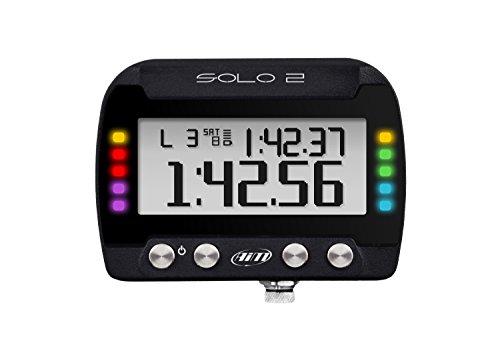
Prices are Amazon’s listed prices as of the date and time shown and are subject to change; the price on Amazon at the time of purchase applies. As an Amazon Associate we earn from qualifying purchases.
Types of Karting Data Logger
Basic lap timer. Shows current, last and best lap. Often uses a magnetic or infrared pickup. Ideal for beginners and four-stroke classes where engine monitoring is less critical.
Lap timer with rpm and temperature. Adds an rpm signal from the spark plug lead and a temperature sensor, typically water temperature, cylinder head temperature or exhaust gas temperature. This is the most common setup in club two-stroke racing.
GPS data logger. Adds GPS speed and position, so you can overlay laps, view speed traces and see exactly where you gain or lose time. Many current dashes include GPS as standard.
Full data acquisition. Adds extra sensors such as steering angle, throttle, brake pressure and accelerometers, plus video integration. Used by serious competitors and teams.
Phone apps and action cameras. Smartphone lap timing apps and GPS-enabled cameras offer a low-cost way to see lap times and video. Accuracy and mounting are limitations, and many race series restrict phones or cameras, so check the rules.
Karting Data Logger Types Compared
| Type | Main Channels | Timing Method | Typical Price Range (USD) | Best For |
|---|---|---|---|---|
| Basic lap timer | Lap times | Magnet or infrared | About $100 to $300 | Beginners, rental leagues |
| Lap timer with rpm and temp | Laps, rpm, one or two temps | Magnet, infrared or GPS | About $300 to $700 | Club two-stroke racers |
| GPS data logger | Laps, rpm, temps, speed, position | GPS | About $500 to $1,000 | Drivers analyzing lines |
| Full data acquisition | All of the above plus extra sensors | GPS plus beacon | $1,000 and up | Advanced racers and teams |
| Phone app or GPS camera | Laps, speed, video | GPS | Low cost to a few hundred dollars | Casual drivers, practice days |
Prices are typical ranges and vary with sensors, display size and software features.
What the Data Tells You
Lap time consistency. Large swings between laps point to driving inconsistency or a setup problem. Consistent laps are the foundation for meaningful setup changes.
Speed traces. Comparing speed through each corner reveals where you brake too early, carry too little speed or get a poor exit. Minimum corner speed and exit speed are particularly useful.
Rpm and gearing. Peak rpm at the end of the longest straight and minimum rpm in the slowest corner help you choose sprocket sizes. Our go-kart sprocket calculator explains how ratio changes affect top speed.
Engine temperatures. Exhaust gas or cylinder head temperature helps two-stroke racers judge carburetor jetting. Running too lean risks seizure, while too rich costs power. Follow your engine builder’s guidance on safe ranges.
Driver comparison. If two drivers share a team or setup, overlaying their laps shows exactly where one gains time. This is one of the fastest ways to learn.
Data reinforces good driving technique; our karting racing line guide pairs well with speed-trace analysis.
A Simple Routine for Using Your Data
Data is only useful if you look at it the same way every time. A simple routine works well for club racers.
Before the session. Note the setup: gearing, tire pressures, jetting and weather. Many loggers let you add notes to each session file.
Straight after the session. Check best lap, peak rpm and maximum temperature while the kart is still on the stand. If temperatures or rpm look wrong, address them before going out again.
Between sessions. Overlay your best lap with another good lap, or with a teammate’s lap. Pick the one or two corners with the biggest time difference and focus on those next time out.
After the event. Save the files, label them clearly and record what changed and what worked. Over a season, this history becomes a valuable setup reference for each track.
How to Choose a Lap Timer or Data Logger
Start with your class rules. Some series limit which channels you may log or whether certain sensors are allowed. Check the current rulebook for your class and sanctioning body.
Match it to your engine. Two-stroke racers benefit most from temperature and rpm channels. Four-stroke racers may prioritize lap times and speed.
Consider GPS. GPS removes the need for a beacon and makes lap comparison much more useful. It is worth paying for if you plan to analyze data.
Look at the software. Good analysis software matters as much as the hardware. Check that it runs on your computer or phone and is easy to use.
Check dealer support. Sensors, cables and mounts wear out. Buy a brand your local dealer stocks so spares are easy to find.
Think about upgrades. Some systems let you add sensors later, so you can start simple and expand as your skills grow.
Installation and Care
Most dashes mount to the steering wheel with brackets or a center pad. Route the rpm lead along the spark plug wire as the manufacturer instructs and fit the temperature sensor in the correct location, such as the exhaust header or head. Secure every cable with ties so nothing can snag on the track or touch hot parts. Keep the unit charged, clean the screen and protect connectors from water and fuel. Back up your session files regularly so you do not lose your history. Always follow the manufacturer’s manual for wiring and sensor placement.
Data equipment is part of a wider pit kit. Our guide to kart racing tools covers what else to bring to the track.
Pros and Cons of a Karting Data Logger
Pros
- Shows exactly where you gain or lose time
- Helps choose gearing and jetting with evidence
- Protects engines through temperature monitoring
- Speeds up learning for new drivers
- GPS units need no trackside equipment
Cons
- Advanced systems are expensive
- Too much data can overwhelm beginners
- Sensors and cables need regular care
- Some series restrict data channels
- Analysis takes time between sessions
Frequently Asked Questions
Do I need a data logger as a beginner?
Is a GPS lap timer accurate enough for karting?
What temperature should I monitor on a two-stroke kart?
Can I use a phone as a karting lap timer?
Is a lap timer the same as a transponder?
Are data loggers allowed in all classes?
Final Thoughts
A karting data logger is one of the most cost-effective tools for getting faster. Start with a dependable lap timer, add rpm and temperature for two-strokes, and move to GPS analysis when you want to compare laps in detail. For more on building a competitive program, see our go-kart racing guide and our collection of kart racing tips.