
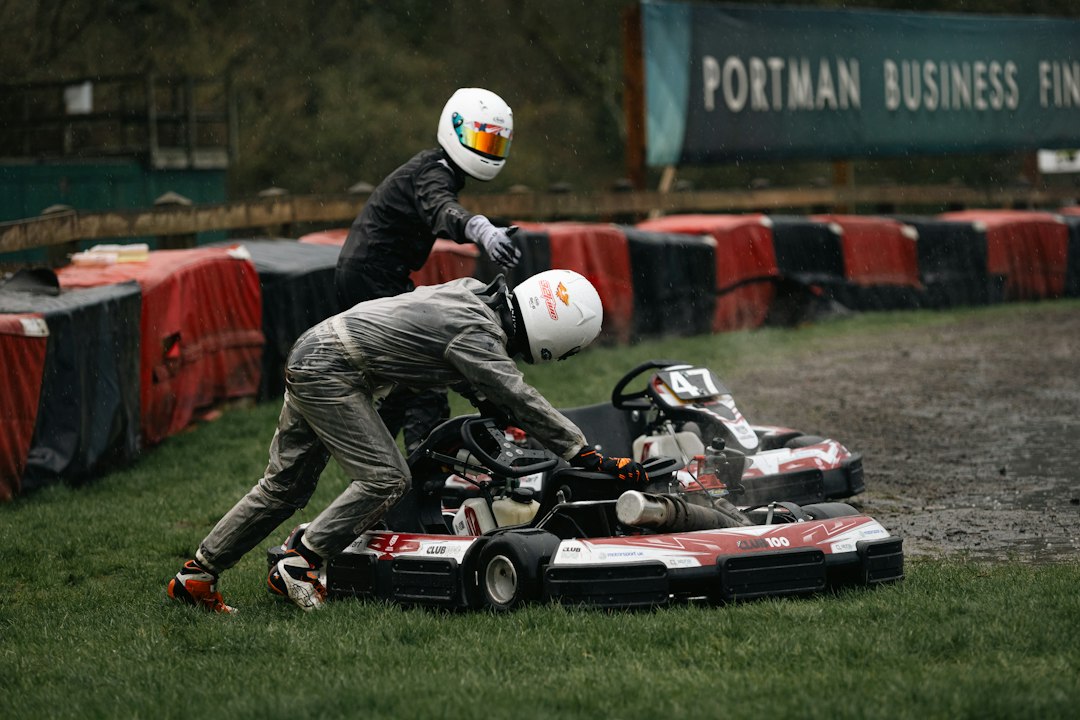
Karting in the rain is a different sport from dry karting. Grip drops sharply, the fastest line moves, inputs must be smoother and the kart usually needs a different setup to generate grip at all. Many drivers dread wet sessions, but they are also where car control is learned and where smart preparation pays off. This guide covers how to drive a kart on a wet track, where to find grip, how wet setups commonly differ from dry ones, what gear keeps you comfortable and seeing clearly, and how rental and racing sessions handle rain. Setup advice is given as tendencies to test against your chassis manufacturer’s wet recommendations, not fixed numbers.
Part of our Kart Racing guide — explore the full guide →
Why the Rain Changes Everything
On a dry track, the tires grip through heat and contact with a rubbered racing line. In the wet, water sits between tire and surface, track temperatures drop and the rubber laid down on the dry line can become one of the most slippery parts of the circuit. Painted curbs, white lines and patches of oil become very low grip.
Karts make this harder because they are light, have no suspension and rely on weight transfer to turn. In low grip, there is less weight transfer, so the inside rear wheel does not lift as easily and the kart tends to push. That is why wet setups usually aim to increase weight transfer and mechanical grip, which is close to the opposite of the dry setup on many chassis.
Driving Technique for Karting in the Rain
Be smooth. Every input, from steering to throttle to brake, should be gentler and more progressive. Sudden inputs break traction instantly.
Brake earlier and lighter. Braking distances grow and the rear locks more easily. Brake in a straight line where possible. Our guide to kart braking technique covers threshold braking in more detail.
Look for grip off the dry line. The rubbered dry line is often slippery when wet, so drivers frequently move off it. That can mean braking and turning in on a wider or tighter path than in the dry and sometimes taking a very different line through a corner to find unrubbered asphalt. Walk the track or watch others to see where water collects and where the surface is rough. Our guide to the karting racing line explains the dry baseline you are deviating from.
Use the kart’s rotation. In the wet, a kart may need to be encouraged to turn. Some drivers use a sharper initial steering input or a brief lift to rotate the kart, then straighten the wheel early to put power down. Practice this carefully; it is easy to overdo.
Avoid curbs and paint. Wet curbs are very slippery. Keep the wheels off them unless you know they offer grip at that track.
Look further ahead. Spray and fogging reduce visibility. Look well ahead, leave more space to other karts and be ready for someone ahead to spin.
Wet Setup Changes Compared
Racing karts are commonly re-set for the wet to help generate grip. The table shows typical directions many teams start from. Your chassis manufacturer’s wet baseline is the right place to begin, and the amount of each change depends on how wet the track is.
| Setting | Typical wet direction | Why | Notes |
|---|---|---|---|
| Tires | Wet tires | Treaded compound clears water and works at low temperature | Officials usually declare a wet race; follow class rules |
| Tire pressure | Often higher than dry | Helps the tire build heat and keep its shape | Depends on tire, temperature and water level |
| Ride height | Often raised | Increases weight transfer in low grip | Check ground clearance and class rules |
| Front track width | Often widened | Adds leverage to lift the inside rear | Effect varies by chassis |
| Rear track width | Often narrowed | Adds rear grip | Within class and safety limits |
| Caster | Often increased | More jacking to help the kart turn | Heavier steering |
| Axle and stays | Softer axle, stays adjusted | More flex and mechanical grip | Follow chassis guidance |
Not every team changes every setting. On a drying track, you may need to undo some of these mid-session or choose a compromise. Our sibling guide to kart tire pressure explains how pressure interacts with the rest of a wet setup.
Damp, Wet and Drying Tracks
Rain is rarely one condition. A fully wet track with standing water, a damp track after a shower and a drying track with a dry line appearing all ask for different approaches.
Fully wet. Grip is low everywhere, so the full wet setup and the off-line approach usually apply. Water depth varies around the lap, so learn where puddles form and where the surface drains well.
Damp. A damp track is often the hardest call. Wet tires may overheat and wear quickly as the surface dries, while dry slicks may not reach working temperature. Watch what the track is doing in the minutes before your session and ask what others in your class are choosing, but make your own decision based on the forecast and the surface.
Drying. As a dry line appears, the grip moves back toward the conventional line, and a full wet setup can start to feel too aggressive, with the kart hopping or bogging. Drivers often look for damp patches on the straights to cool wet tires. Where class rules allow tire changes, the timing of that switch can decide a race; where they do not, you adapt your driving to the tires you have.
Before a Wet Session
- Fit wet tires and set pressures from your baseline, then adjust after a few laps.
- Apply anti-fog to the visor and check the breath deflector.
- Cover the air intake and protect electronics.
- Check brakes; a wet disc and pads can feel different for the first few applications.
- Put on your rain suit and wet-weather gloves.
- Walk or watch the track to spot standing water and grippy patches.
Engine and Drivetrain Considerations
Some teams adjust gearing in the wet because corner speeds are lower and the kart spends longer at low revs. Carbureted engines may also be re-jetted as air temperature and humidity change. Both depend heavily on the engine, class and track; refer to the engine manufacturer’s guidance and your class rules, which may restrict what you can change.
Water can also get into electronics and the air intake. Many racers fit a rain cover over the air box and protect timing transponders, data loggers and ignition connections.
Gear for Wet Sessions
Rain suit. A waterproof oversuit keeps you dry and warm, which helps concentration. Wear it over your normal suit if your class requires a race suit. Our guide to karting rain suits covers sizes and features.
Visor. Fogging is a major problem in the rain. Anti-fog treatments, a breath deflector and, on some helmets, a double-layer visor help. A visor slightly cracked open can help on the straights, but check that your helmet allows it safely.
Gloves. Wet-weather gloves with good grip help keep control of the wheel.
Boots. Make sure your boots grip the pedals when wet.
Rental Karting in the Rain
Outdoor rental tracks often run in light rain with the same karts. The karts cannot be re-set, so technique is everything: be smooth, brake earlier and leave extra space. Tracks may stop sessions in heavy rain or standing water. Indoor tracks avoid the issue altogether, which is one reason they are popular in wet climates.
Safety
Visibility drops in spray, so increase your gap to the kart ahead and avoid lunges. Spinning karts are harder to avoid on a wet surface. If you lose control, keep your hands on the wheel and your feet in the kart. Follow the officials’ flags and race direction, and respect any session stops due to standing water. Check that brakes, tires and the kart are suitable for the conditions before you go out.
Pros and Cons
Wet sessions have a reputation, but they also bring real benefits.
Pros
- Teaches car control and smoothness faster than dry sessions
- Reduces the advantage of raw horsepower
- Rewards preparation and good wet setup
- Builds confidence for mixed-weather race days
Cons
- Lower grip means more spins and contact
- Setup changes take time and may need undoing on a drying track
- Visibility and comfort suffer without proper gear
- Wet tires and extra kit add cost
Frequently Asked Questions
Can you go karting in the rain?
What line should I take in the wet?
Do I need different tires for rain karting?
Should tire pressures be higher in the rain?
How do I stop my visor fogging?
Is karting in the rain dangerous?
Final Thoughts
Karting in the rain rewards smoothness, patience and preparation. Find grip off the dry line, brake earlier and gentler and re-set the kart from your chassis maker’s wet baseline. For more ways to improve your driving in any conditions, read our kart racing tips and explore the go-kart racing hub.