
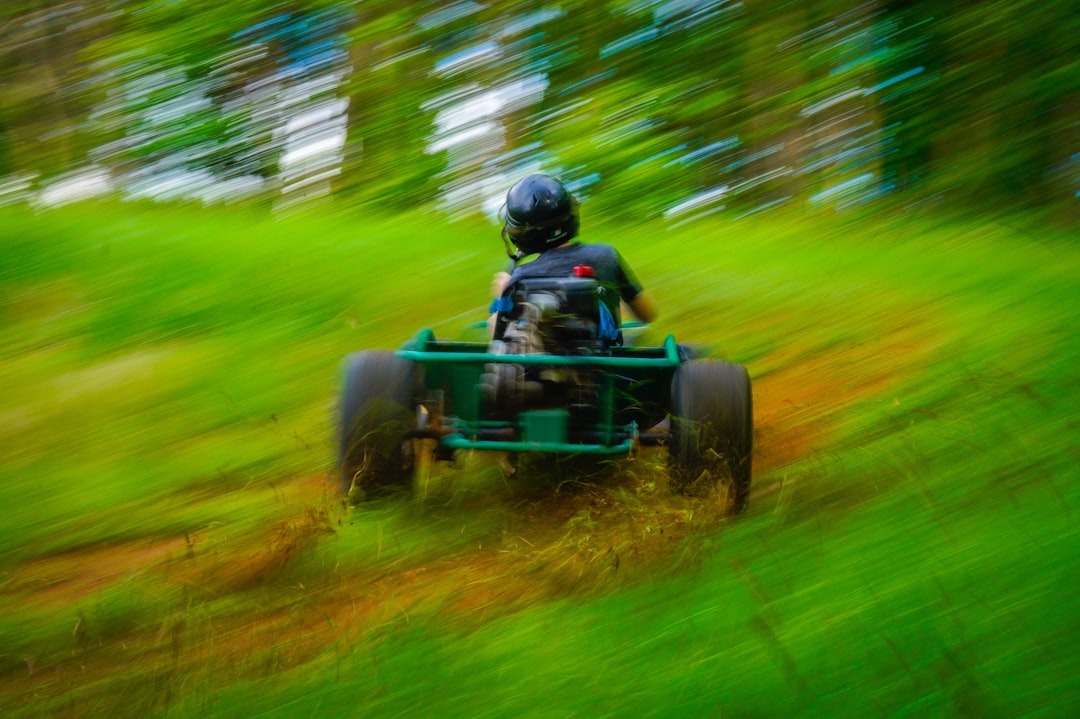
Getting off road go kart suspension right is what separates a kart that skips and bucks across rough ground from one that stays planted, steers straight, and lands jumps without bending metal. Unlike sprint karts, which run rigid frames, off-road karts rely on a full suspension system — typically double A-arms up front and a swingarm or trailing arms at the rear — to keep the tires in contact with dirt, roots, and ruts. This guide covers how the whole system works together, how much travel you actually need, spring and damper basics, and how to set up sag and preload so the kart rides the way it should.
How Off Road Go Kart Suspension Works
An off-road kart suspension has one job: keep the contact patch on the ground while the chassis stays controlled. It does this with three elements working together — linkage geometry, springs, and dampers.
Up front, most karts use a double A-arm (double wishbone) layout. Two stacked arms locate each front wheel and let it move vertically while the coilover shock, mounted between the lower arm and the frame, controls that movement. The geometry sets camber, caster, and scrub radius, which is why arm length and mounting points matter as much as the shock itself. We break the front end down in detail in our guide to go-kart front suspension design.
At the rear, the common solutions are a single swingarm (like a dirt bike, carrying a live axle) or twin trailing arms with independent or semi-independent movement. The rear takes the biggest hits — landings, whoops, and acceleration squat — so it usually runs more travel and stiffer springs than the front. Our companion piece on the go-kart rear suspension kit covers swingarm and coilover options component by component.
Suspension Types and Travel by Tier
Travel numbers tell you a lot about what a kart can handle. Here is how the market breaks down.
Entry-level yard karts. Many budget off-road karts run 3–5 inches of travel with basic non-adjustable coilovers, sometimes only at the rear. Fine for grass and smooth trails, but they blow through their travel on anything rough.
Mid-tier trail karts and buggies. The 150–300cc class typically carries 5–8 inches of travel front and rear, with preload-adjustable coilovers and proper A-arm front ends. This tier handles real trail riding, small jumps, and rutted terrain.
Cross karts and race buggies. Serious machines run 8–12 inches of travel with rebound- and sometimes compression-adjustable dampers, chromoly arms, and reservoir shocks. If you are shopping in this space, our roundup of the best off-road go-karts compares full builds side by side.
Suspension Tiers Compared
| Tier | Front setup | Rear setup | Travel | Adjustability |
|---|---|---|---|---|
| Entry yard kart | Basic A-arms or rigid | Twin coilovers on swingarm | 3–5 in | None or preload only |
| Mid-tier trail kart | Double A-arm coilovers | Swingarm or trailing arms | 5–8 in | Preload, sometimes rebound |
| Cross kart / race buggy | Long-travel double A-arm | Long swingarm, mono or twin shock | 8–12 in | Preload, rebound, compression |
| Custom build | Builder-defined | Builder-defined | Varies | Depends on shock choice |
Springs and Dampers: The Basics
The spring holds the kart up and stores energy when the wheel hits a bump; the damper turns that energy into heat so the kart does not pogo. Spring rate is measured in pounds per inch (or N/mm) — a heavier kart or rider needs a higher rate, and the rear generally runs 20–40 percent stiffer than the front because it carries the engine and most of the driver’s weight.
Damping splits into compression (how fast the shock squeezes) and rebound (how fast it extends). Too little rebound damping and the kart bounces after every hit; too much and the suspension “packs down” over repeated bumps because it cannot extend fast enough. Entry shocks fix these values internally; better coilovers let you dial them with a clicker or adjustment ring.
Cost and Considerations
A pair of basic preload-adjustable coilovers runs $40–$120. Mid-grade ATV-style shocks with rebound adjustment land around $150–$400 per pair, and long-travel reservoir shocks for cross karts can hit $300–$800 each. Add A-arms ($50–$200 per side), heim joints, and bushings, and a full front-and-rear system on a custom build commonly totals $500–$2,000.
Budget beyond parts, too. Heim joints and bushings are wear items on dirt karts, bent A-arms are a fact of life after hard landings, and shocks eventually need seals or replacement. Buy shocks with commonly available eyelet sizes and spring diameters so rebuilds and rate changes stay cheap.
Setup: Sag, Preload, and Tuning Order
Setup starts with sag — how much the suspension compresses under the kart’s weight plus the driver. Aim for roughly 25–33 percent of total travel used at static ride height. Measure the shock fully extended, then measure again with the driver seated, and adjust the spring preload collar until the difference lands in that window.
If you run out of preload adjustment trying to hit sag, the spring rate is wrong — do not crank a soft spring into coil bind. After sag, tune rebound: push down hard on a corner and release; the kart should return once, smoothly, without bouncing. Set compression last, softening it if the ride feels harsh over small chop and firming it if you bottom out on landings. Change one thing at a time and test on the same stretch of terrain.
Pros and Cons
Full suspension transforms what a kart can do off-road, but it adds complexity a rigid frame never has.
Pros
- Keeps tires planted on rough terrain for real traction and control
- Absorbs jumps and hard landings that would bend a rigid frame
- Dramatically improves ride comfort and reduces driver fatigue
- Adjustable systems can be tuned for driver weight and terrain
Cons
- Adds cost, weight, and mechanical complexity
- Heim joints, bushings, and shocks are ongoing wear items
- Poorly set up suspension handles worse than no suspension
- Geometry design mistakes on custom builds cause bump steer and wear
Frequently Asked Questions
Do off-road go-karts need suspension?
How much suspension travel does an off-road kart need?
What is sag and why does it matter?
Can I add suspension to a rigid go-kart frame?
Should the rear springs be stiffer than the front?
Are ATV shocks a good option for go-kart suspension?
Final Thoughts
A dialed-in off road go kart suspension system is the difference between surviving rough terrain and actually attacking it. Get the geometry right first, choose spring rates for your combined kart-and-driver weight, then set sag before touching damping adjusters. Start with the front end in our front suspension design guide, sort the back with the rear suspension kit guide, and if you would rather buy than build, the best off-road go-karts roundup shows which factory machines get the system right out of the box.