
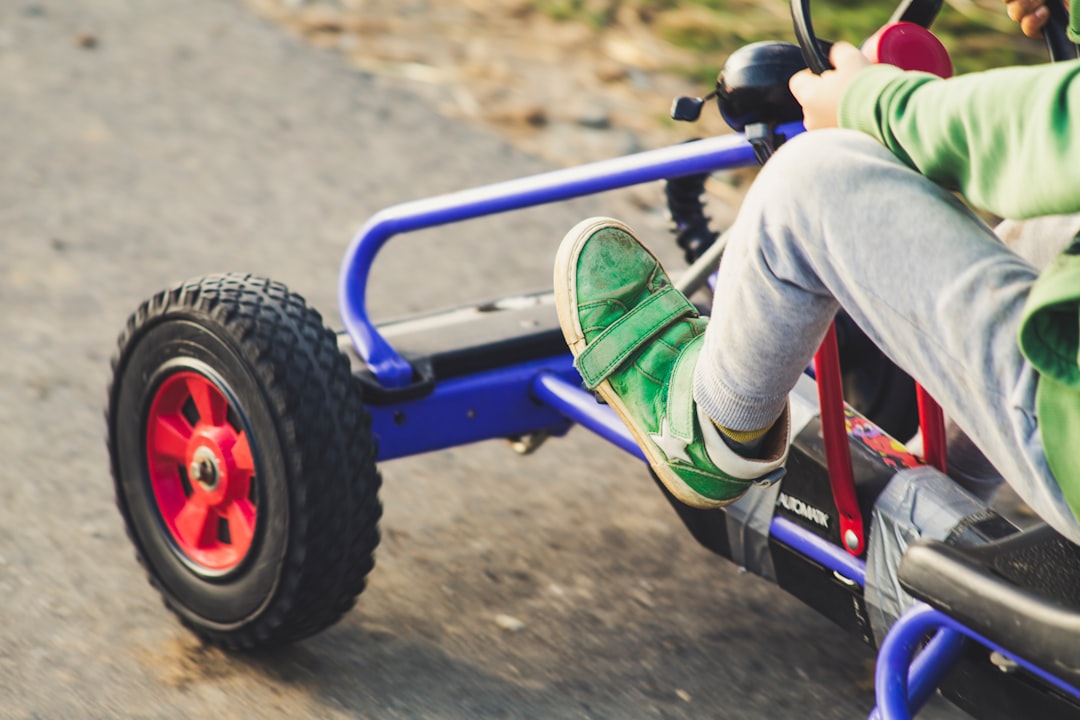
The best pedal go-kart for 8–12 year olds is a full-size, adjustable model rather than a toddler kart sized up. Look for a steel frame, a seat or pedal assembly with several positions, a freewheel, a reliable handbrake, and air-filled (pneumatic) tires if your child will ride beyond smooth pavement. A good big-kid pedal kart is typically rated to somewhere around 110–150 lbs and, if sized correctly, can last through the whole age range. Expect to pay roughly $150–$300 for compact models and $300–$800 for larger, better-built karts. This guide covers sizing, tire choice, types, costs, safety, and how pedal karts compare with electric at this age.
Part of our Kids Go-Karts guide — explore the full guide →
What Is a Pedal Go-Kart for 8 to 12 Year Olds?
A pedal go-kart is a four-wheeled kart powered by the rider’s legs through a chain, similar to a recumbent bike but with a kart’s low, stable stance and steering wheel. Big-kid models are built for longer legs and heavier riders than preschool pedal karts, with stronger frames, wider adjustment ranges, and better brakes.
The key features to look for are a freewheel (so the pedals stop turning while coasting), a handbrake acting on the rear wheels, adjustable seat or pedal positions, and a low center of gravity. Speed is whatever the rider produces — typically a jog-to-bike pace, around 5–10 mph on flat ground for strong riders — which is part of why many parents choose pedal power at this age. For the broader category, our pedal go-kart guide covers every age group.
Types of Pedal Go-Karts for 8 to 12 Year Olds
Compact street karts. Lighter frames, often with EVA foam tires. Best for younger riders in this range on smooth pavement, and easier to store. Many children outgrow them by 10 or 11.
Large-frame karts. The core of the class: longer frames, pneumatic tires, a wide adjustment range, and higher weight ratings. Many fit young teens too.
Off-road pedal karts. Large frames with deep-tread pneumatic tires and more clearance for grass, gravel, and packed dirt. Heavier to pedal on pavement, but much more versatile. Our off-road pedal kart guide goes deeper.
Premium performance karts. Higher-end karts with features such as pivoting front axles that keep all four wheels on uneven ground, optional gearing, and better bearings and components. They cost more but are often built to survive several children.
Two-seat karts. Some families prefer a side-by-side layout for siblings or friends; see our two-seater pedal kart guide for the trade-offs.
Best Go-Karts for Kids by Age (2026 Buying Guide): our top 3 picks
| Product | Best for | Key features | Price | Buy |
|---|---|---|---|---|
| Qaba Pedal Go Kart (3-5) | Best for ages 3 to 5 |
| $66.49as of Oct 26, 2026 10:01 am EDT | Buy now →Check current price |
| hauck Hurricane Pedal Kart | Best for ages 4 to 10 |
| $189.99as of Oct 26, 2026 10:01 am EDT | Buy now →Check current price |
| Aosom Pedal Go Kart (5-12) | Best pedal kart for ages 5 to 12 |
| $164.99as of Oct 26, 2026 10:01 am EDT | Buy now →Check current price |


Prices are Amazon’s listed prices as of the date and time shown and are subject to change; the price on Amazon at the time of purchase applies. As an Amazon Associate we earn from qualifying purchases.
See every pick compared: Best Go-Karts for Kids by Age (2026 Buying Guide) →
Pedal Go-Karts for 8 to 12 Year Olds Compared
Use the manufacturer’s weight rating and adjustment range, not the age on the box, as your sizing guide. Prices and ratings below are typical ranges.
| Type | Best fit | Tires | Typical weight rating | Approx. price |
|---|---|---|---|---|
| Compact street | About 8–10 years | EVA foam | Around 100–120 lbs | $150–$300 |
| Large-frame | About 9–12+ years | Pneumatic | Around 130–150 lbs | $300–$500 |
| Off-road | About 9–12+ years | Pneumatic, knobby | Around 130–150 lbs | $350–$600 |
| Premium performance | About 8–14 years | Pneumatic | Varies; often higher | $500–$800+ |
How to Size a Pedal Kart Correctly
Fit matters more than any other spec. With the seat or pedals adjusted, your child should reach the pedals at the bottom of the stroke with a slight bend in the knee, and steer without the knees hitting the wheel. Ideally there should be at least two more adjustment positions left so the kart can grow with them.
If your child is 10 or older, or tall for their age, skip compact karts and go straight to a large frame. A rider whose knees come up toward the steering wheel tires quickly and loses interest. Check that the weight rating leaves headroom for a growth spurt.
Pneumatic vs EVA Tires
This single choice shapes how the kart rides. Pneumatic tires are air-filled, like bike tires. They ride more smoothly, grip better, and roll more easily over grass and gravel, but they can puncture and need occasional pressure checks.
EVA foam tires never go flat and need no maintenance, but they ride harder, are noisier on rough pavement, and struggle on loose or soft ground. For 8–12 year olds who will ride beyond the driveway, pneumatic tires are usually worth the minor upkeep. EVA makes sense for pavement-only riding or if you want zero maintenance.
Cost and What You Get
At roughly $150–$300, compact steel frames with EVA tires are a fair choice for a younger rider on pavement, but may be outgrown within a couple of years. Around $300–$500 is the value range for many families: larger frames, pneumatic tires, a wider adjustment range, and ratings that cover most of the age span. Premium karts from about $500 upward add stronger components and features such as pivoting axles, and well-made ones tend to hold resale value.
A pedal kart also has very low running costs: no charging, no fuel, and only occasional tire, chain, and brake attention. Compared with a 24V electric go-kart at similar money, it trades motorized speed for exercise and a longer usable life.
Pedal vs Electric at This Age
Pedal karts suit children who enjoy being active, families who want minimal maintenance, and anyone who prefers speeds limited by the rider’s own effort. Electric karts suit children who are motivated by motorized speed and parents comfortable supervising a powered vehicle. Some families have both. If your child is near 12 and pushing for more speed, our best go-karts for kids by age guide outlines the natural next steps, and go-karting age explains age guidance at rental tracks.
Safety Tips for Big-Kid Pedal Karts
Pedal karts are among the gentlest kart types, but they still need sensible rules. Ride in a driveway, park path, cul-de-sac, or yard away from traffic, and never on public roads. Low karts are hard for drivers to see, so a safety flag is a good idea near any area with vehicles. A properly fitted helmet is a smart habit; our go-kart helmets for kids guide covers sizing. Check the handbrake works before every ride, and teach your child to brake before downhill sections, since pedal karts can gather surprising speed on slopes.
What to Check Before You Buy
- Adjustment range. How many seat or pedal positions are there, and what leg length do they cover?
- Weight rating. Confirm the maximum rider weight and leave room for growth.
- Freewheel. Pedals that keep spinning while coasting are uncomfortable and can catch feet.
- Brake type. A handbrake acting on the rear wheels is standard on better karts; test that it is easy for a child to pull firmly.
- Frame finish. Powder-coated steel resists rust better than basic paint, which matters if the kart lives outdoors.
- Assembly and parts. Check that replacement tires, tubes, chains, and seats are available by model number.
- Size and weight. Measure your storage space and car trunk; large-frame karts are long and heavy.
Assembly typically takes an hour or two with basic tools. Once built, check chain tension, brake adjustment, and tire pressure before the first ride, and re-tighten bolts after the first week of use.
Maintenance
Pedal karts need very little care. Check tire pressure every few weeks on pneumatic tires, keep the chain lightly lubricated and correctly tensioned, and inspect the handbrake cable or linkage for wear. Tighten bolts at the start of each season, and store the kart under cover to prevent rust and sun damage to the seat and tires.
Pros and Cons of Pedal Go-Karts for 8 to 12 Year Olds
Pros
- Built-in exercise with no battery or fuel
- Adjustable frames can cover the whole 8 to 12 range
- Very low running and maintenance costs
- Speed is limited by the rider, which suits cautious parents
- Quiet enough for any neighborhood
Cons
- Kids chasing motorized speed may lose interest by 11 or 12
- Quality large-frame karts cost as much as entry electric karts
- Steel frames are heavy and awkward to transport
- EVA-tired models are limited to smooth pavement
Frequently Asked Questions
What size pedal go-kart does a 10 year old need?
How fast do pedal go-karts go?
Are pneumatic or EVA tires better for kids pedal karts?
Can a 12 year old still use a pedal go-kart?
Is a pedal go-kart good exercise for kids?
Should I buy a pedal kart or an electric kart at this age?
Final Thoughts
For the 8–12 window, a well-sized pedal go-kart is one of the best-value purchases in kids’ karting. Prioritize fit, weight rating, and adjustment range over the age on the box, choose pneumatic tires unless your child rides only on smooth pavement, and insist on a freewheel and a good handbrake. When your child is ready for more, our kids’ go-karts complete guide covers the next stage.