

A childrens electric go kart is often a young child’s first taste of driving, so safety features and sizing matter far more than raw speed. Electric karts have no gas to mix, no pull-start, no hot exhaust, and no engine to tune, and most let a parent cap the speed or stop the kart from a distance. That combination is why they dominate the family market. This guide explains how these karts work, the main types by age and battery voltage, typical costs, the safety and charging basics every parent should know, and how to choose a kart your child will grow into rather than out of in a single summer.
Part of our Kids Go-Karts guide — explore the full guide →
What Is a Childrens Electric Go Kart?
A childrens electric go kart is a battery-powered ride-on with a seat, steering wheel, and foot pedal, sized and speed-limited for young drivers. A rechargeable battery, usually 6V, 12V, or 24V on models for younger kids, feeds a controller that regulates power to one or two drive motors. Press the pedal and the kart moves; release it and the kart slows.
The defining advantage for parents is control. Most quality models offer two or more speed settings, and many include a parental remote that can slow, steer, or stop the kart instantly. That makes an electric kart far easier to supervise than a gas kart, and it turns a driveway into a safe practice space during those first nervous laps.
The design deliberately trades excitement for stability. Steering is geared to be slow rather than twitchy, the frame sits low with a wide track to resist tipping, and the throttle ramps gently. Because there is no clutch, no shifting, and no engine noise, children can focus on steering and braking instead of managing a machine.
How Electric Kids’ Karts Work
Electric motors deliver torque instantly from a standstill. That makes them predictable, since there is no clutch engagement surge as on a gas kart, but it also means even a “slow” kart can feel eager off the line. A good controller softens the start so a nervous child is not jolted backward, and this is one reason the speed limiter is such an important feature for new drivers.
Drive layout matters too. Single-motor karts usually drive one rear wheel, which is the simplest and cheapest arrangement and works fine on smooth pavement. Dual-motor karts drive both rear wheels for better traction on grass, slight slopes, and uneven ground. If your yard is anything other than flat and hard, dual drive is worth looking for.
Braking on most young-child karts is simple: lifting off the pedal engages an electric brake or lets the motor slow the kart, and some models add a separate foot or hand brake. Teach your child to brake before you teach them to go faster.
Best Electric Go-Kart for Kids: our top 3 picks
| Product | Best for | Key features | Price | Buy |
|---|---|---|---|---|
| STARRIVER 24V Drift Kart | Best overall for ages 6-12 |
| $339.99as of Nov 17, 2026 3:02 pm EST | Buy now →Check current price |
| Aosom 24V Drift Kart | Best for bigger kids aged 8-12 |
| $244.99as of Nov 17, 2026 3:02 pm EST | Buy now →Check current price |
| SaveJoy 12V Drift Cart | Best safety-certified pick |
| $139.99as of Nov 17, 2026 11:11 am EST | Buy now →Check current price |


Prices are Amazon’s listed prices as of the date and time shown and are subject to change; the price on Amazon at the time of purchase applies. As an Amazon Associate we earn from qualifying purchases.
Types of Childrens Electric Go-Karts
Battery voltage roughly tracks age and speed, which makes it a useful shorthand when shopping. Exact speeds vary by model, weight, and surface, so treat these as typical ranges and check the manufacturer’s stated age and weight limits.
6V toddler karts run very slowly, around 2 to 3 mph, for children from roughly 18 months to 3 years on smooth, flat surfaces. Many feel closer to a ride-on toy than a kart.
Remote-control 12V karts let a parent fully override steering and braking. They are ideal for ages 3 to 5 and for any child who has never driven before.
Standard 12V karts give simple forward-and-reverse driving at roughly 2 to 6 mph. This is the most popular family category for confident preschoolers and early primary-age children, roughly ages 3 to 7.
24V karts with a limiter step up to roughly 5 to 12 mph for ages 6 to 10 or so, while keeping a slow starter setting. They suit larger yards and children who have mastered basic control.
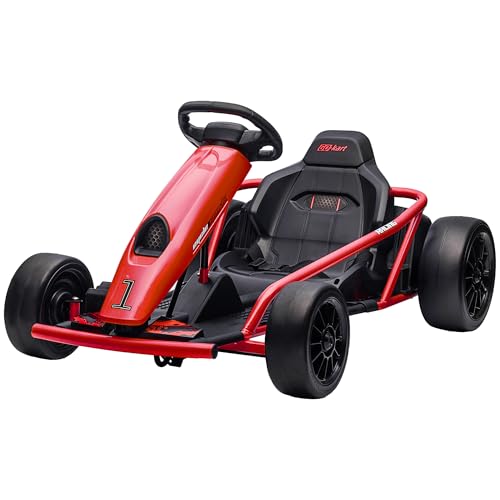
Drift-style kids’ karts use slick rear casters so children can slide through corners at low speed. They are great fun on flat, enclosed pavement but need more space and supervision than a standard kart. Our best drift kart for kids guide covers this category in detail.
Beyond these sit 36V and higher youth performance karts reaching 10 to 15 mph or more, aimed at older kids and teens. They are a different product with different safety demands, and most children should graduate to one only after time on a slower kart.
Speed should always follow age and experience, not the other way around. A cautious eight-year-old is better served by a capped 24V kart than an underused performance model, while a bold ten-year-old will be bored on a 12V machine within weeks.
Childrens Electric Kart Types Compared
| Type | Voltage | Typical Ages | Typical Top Speed | Key Safety Feature | Typical Price Range |
|---|---|---|---|---|---|
| Toddler ride-on | 6V | 1.5-3 | 2-3 mph | Very low fixed speed | $60-$150 |
| Remote-control 12V | 12V | 3-5 | 2-4 mph | Full parent override | $150-$400 |
| Standard 12V | 12V | 3-7 | 2-6 mph | Low speed, forward/reverse | $120-$350 |
| 24V with limiter | 24V | 6-10 | 5-12 mph | Selectable speed setting | $250-$700 |
| Drift-style | 12-24V | 6-12 | 5-10 mph | Low-grip, controlled slides | $150-$500 |
Cost and Considerations
Price tracks voltage and features more than anything else. Simple 6V toddler karts usually sit around $60 to $150, 12V models around $120 to $400 depending on remote control and tire quality, and 24V karts with a limiter around $250 to $700. Youth performance karts for older children typically run $500 to $1,200 and up. Our go-kart cost guide sets these numbers against the wider kart market.
Look beyond the sticker price. The battery is the wear item: it loses capacity over a few years and eventually needs replacing. A kart with a removable, standard-size sealed lead-acid or lithium pack is much cheaper to keep running than one with a sealed, proprietary battery that may be discontinued. Before buying, confirm that replacement packs and chargers are actually available.
Run time and charge time matter enormously to a small child’s attention span. Budget karts often give 30 to 45 minutes of driving, while better models reach 60 to 90 minutes. Charge times of 8 to 12 hours are common, so a spare battery or second charger can double a play session without waiting overnight.
Think about longevity too. Young children grow quickly and outgrow slow karts. A model with an adjustable seat, adjustable pedals, and a raisable speed cap can serve for two or three years instead of one season, which turns what looks like a disposable toy into much better value. Spending a little more for a parent remote and better tires usually pays off in both safety and how long the kart stays fun.
How to Choose a Childrens Electric Go-Kart
Start with the child, not the spec sheet. Choose a voltage and speed appropriate for their age, size, and coordination, and lean conservative. A child grows into a slightly slow kart safely; an overpowered one invites accidents.
- Insist on speed control. A parent-adjustable limiter is the minimum. For toddlers and first-timers, a remote override is the single most useful feature.
- Check fit and limits. Confirm seat and pedal reach fit your child now and adjust for growth, and check the weight and height limits so the kart is not underpowered.
- Match the terrain. Wide EVA foam, rubber, or pneumatic tires and a broad stance handle grass and cracked pavement far better than narrow hard plastic wheels, which struggle on anything but smooth surfaces.
- Prioritize brakes and restraint. A reliable brake and a real seatbelt anchored to the frame, not the plastic body, matter more than top speed.
- Judge build quality. Look for a sturdy steering column with minimal play and owner feedback that mentions the kart surviving more than one season.
- Favor supported brands. Makers that sell spare parts, chargers, and batteries are worth a premium, because a well-supported kart can be kept running cheaply for years.
For specific picks matched to each age band, see our best go-karts for kids by age roundup and the best electric go-kart for kids list. If you are still weighing power sources, our electric vs gas go-kart comparison lays out the trade-offs.
Safety, Charging, and Maintenance Basics
Electric karts are low-maintenance, but supervision is non-negotiable with young children.
Safety: a properly fitted helmet is essential on every ride, even at 3 mph, along with closed shoes. Knee and elbow pads are sensible on faster 24V models. Our go-kart helmets for kids guide explains child sizing. Drive only in a flat, enclosed area away from traffic, water, slopes, drop-offs, and hard obstacles. Always supervise, start new drivers on the lowest setting, and raise the speed only as control improves.
Sharing: never put a passenger on a single-seat kart. Only two-seat models rated for the combined weight should carry two children; overloading strains the motor and battery and compromises stability and braking.
Charging: use only the supplied or manufacturer-approved charger, follow the recommended charge time rather than leaving the kart plugged in indefinitely, and store the battery indoors in a dry place. Charge after each use and top up every few weeks during storage to preserve battery life. The owner’s manual is the final word on charging for your specific battery type.
Maintenance: check tire pressure or wear, confirm bolts and steering connections are tight, keep battery terminals clean, and inspect wiring for damage. That is essentially the whole list, a major advantage over gas karts with their oil, fuel, and engine servicing. For a deeper look at batteries and motors, see the electric go-karts complete guide, and for broader rules and supervision advice, the kids go-karts complete guide.
When to Move Up
Signs a child is ready for a faster kart include consistently smooth braking, looking ahead rather than at their hands, and boredom at the highest limiter setting. Move up one step at a time, typically from 12V to 24V, and keep the new kart on its lowest setting for the first few sessions. Older children who want more speed than a backyard kart offers are often better served by an arrive-and-drive session at a supervised track than by a faster home kart.
Pros and Cons
For younger children, these karts are hard to beat, but the same features that make them safe also cap their appeal as kids grow.
Pros
- Built-in speed limiter and remote override options
- Stable, low, wide design resists tipping
- Quiet and clean with no gas, oil, or fumes
- Very low maintenance with no engine tuning
- Gentle introduction to driving for first-timers
Cons
- Low top speed bores older kids quickly
- Short run time on budget models
- Long charge times without a spare battery
- Batteries degrade and need replacing
- Cheaper models use flimsy plastic parts
Frequently Asked Questions
What age is a childrens electric go-kart for?
How fast should a childrens electric go-kart go?
Is a remote control worth it?
How long does the battery last per charge?
Do kids electric go-karts work on grass?
Electric or gas go-kart for a young child?
Can a childrens electric go-kart be used indoors?
Final Thoughts
A childrens electric go kart is the safest, simplest way to give a young child the thrill of driving, provided you lead with the speed limiter, remote override, good tires, and a stable, well-fitted design rather than chasing speed. Add a proper helmet, a safe enclosed space, and close supervision, and the kart can carry a child from cautious first laps to confident driving. Match the kart to your child using our best go-karts for kids by age guide before you buy.