
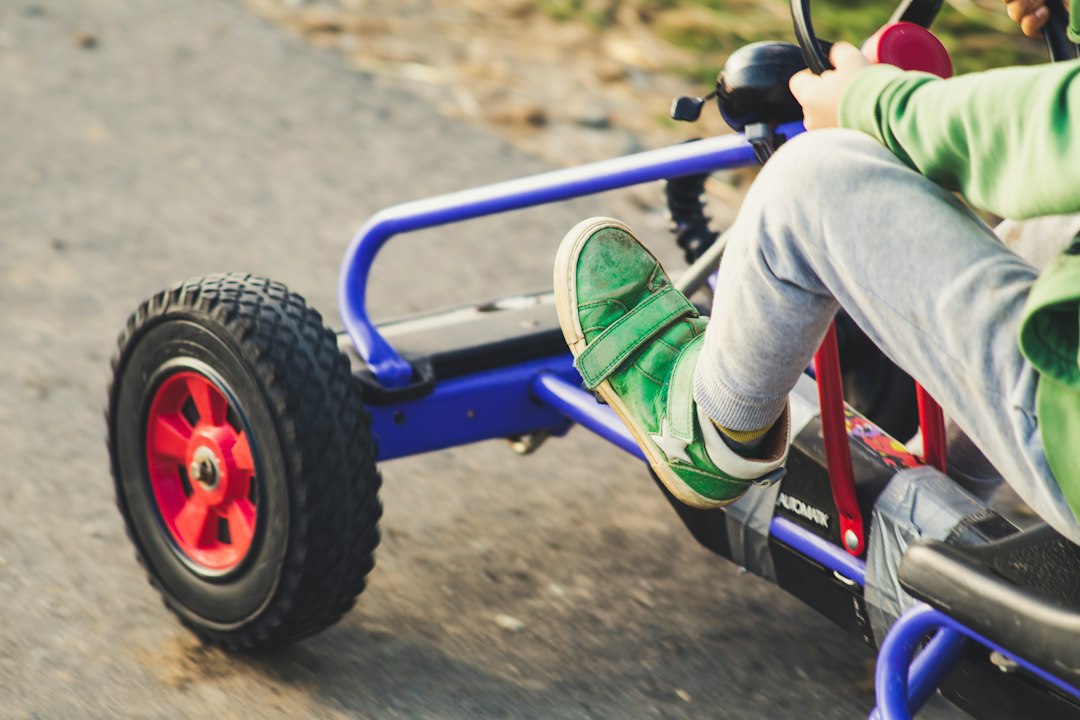
A children’s pedal go kart is often the first vehicle a child truly drives. It teaches steering, braking and awareness of space while building leg strength, all at speeds a parent can comfortably supervise. Pedal karts for kids come in a wide range of sizes, from plastic toddler karts to sturdy steel models with hand brakes and adjustable seats. Choosing well means matching the kart to the child’s age and size, checking that it has suitable brakes and tires, and picking a design that will last. This guide covers types by age, sizing, safety features, costs and maintenance.
Part of our Kids Go-Karts guide — explore the full guide →
What Is a Children’s Pedal Go-Kart?
A children’s pedal go-kart is a four-wheeled ride-on vehicle powered by the child’s legs. The child sits low behind a steering wheel and pushes pedals that drive the rear wheels through a direct crank or a chain. There is no motor or battery, so speed depends entirely on the child.
Pedal karts sit between ride-on toys and motorized karts. They offer more speed and control than push toys but far less risk than gas or electric karts. For the broader picture of kids karts, including motorized options, see our complete kids go-kart guide.
Types of Children’s Pedal Go-Karts by Age
Toddler pedal karts (about 2 to 4 years) are small, light and usually made of plastic. They use direct drive and simple steering, and some have push handles for parents. Speeds are very low.
Preschool and early school karts (about 3 to 7 years) often use steel or reinforced plastic frames, adjustable seats and rubber or EVA tires. Some include a basic brake or freewheel.
Older kids pedal karts (about 6 to 12 years) are larger, often with chain drive, a freewheel, hand brakes and pneumatic tires. Some have gears. Our pedal go-karts for 8 to 12 year olds guide focuses on this group.
Tween and teen pedal karts overlap with adult models, with larger frames and higher weight limits. These suit children who have outgrown standard kids models.
Best Go-Karts for Kids by Age (2026 Buying Guide): our top 3 picks
| Product | Best for | Key features | Price | Buy |
|---|---|---|---|---|
| Qaba Pedal Go Kart (3-5) | Best for ages 3 to 5 |
| $66.49as of Oct 25, 2026 4:49 am EDT | Buy now →Check current price |
| hauck Hurricane Pedal Kart | Best for ages 4 to 10 |
| $189.99as of Oct 25, 2026 4:49 am EDT | Buy now →Check current price |
| Aosom Pedal Go Kart (5-12) | Best pedal kart for ages 5 to 12 |
| $164.99as of Oct 25, 2026 4:49 am EDT | Buy now →Check current price |


Prices are Amazon’s listed prices as of the date and time shown and are subject to change; the price on Amazon at the time of purchase applies. As an Amazon Associate we earn from qualifying purchases.
See every pick compared: Best Go-Karts for Kids by Age (2026 Buying Guide) →
Children’s Pedal Kart Types Compared
| Type | Typical Age | Frame | Drive and Brakes | Typical Price Range |
|---|---|---|---|---|
| Toddler pedal kart | About 2 to 4 | Plastic | Direct drive, no brake | $50 to $120 |
| Preschool and early school | About 3 to 7 | Steel or reinforced plastic | Direct or freewheel, basic brake | $80 to $250 |
| Older kids kart | About 6 to 12 | Steel | Chain, freewheel, hand brake | $150 to $450 |
| Tween and teen | About 10 and up | Steel | Chain, often geared, hand brake | $250 to $700 |
Age ranges are typical; always follow the manufacturer weight and height guidance for the specific model.
Sizing a Pedal Kart for Your Child
Age is a starting point, but size matters more. Measure the child’s inseam or leg length while seated and compare it with the manufacturer’s seat-to-pedal range. The child should be able to push the pedals through a full rotation without stretching, and reach the steering wheel with relaxed arms.
Adjustable seats or pedal positions make a big difference. A kart with several seat positions can last two or three years longer as the child grows. Check the maximum weight rating too, especially if siblings will share the kart.
If the child is between sizes, choose the larger kart only if they can safely reach the pedals and brakes in the closest seat position. A kart that is too big is harder to control.
Safety Features to Look For
Brakes are the most important safety feature on larger pedal karts. Hand brakes or coaster brakes give children a reliable way to slow down, especially on slopes. Toddler karts usually rely on the child stopping pedaling, which is acceptable only at very low speeds on flat ground.
Look for a low center of gravity and wide wheelbase to reduce tipping. Seat belts are a useful addition on larger karts. Safety flags make karts more visible in driveways and parks.
A helmet is a good idea for children riding pedal karts, especially on hard surfaces or near slopes. Our kids go-kart helmet guide explains fit and certification basics.
Check for pinch points around the chain and steering. Chain guards should cover the chain fully, and steering linkages should not trap fingers.
Cost of a Children’s Pedal Go-Kart
Toddler pedal karts usually cost $50 to $120. Preschool and early school models often range from $80 to $250. Larger steel kids karts with hand brakes typically cost $150 to $450, and tween and teen models can reach $700.
Running costs are low. Expect occasional tire replacement, chain lubrication and brake adjustments. Steel frames with powder coating and quality bearings tend to last longest, and many are handed down between siblings or resold.
How to Choose a Children’s Pedal Go-Kart
Match the kart to the child’s size and ability. Confirm seat-to-pedal distance, weight limit and seat adjustability.
Choose the right frame. Plastic suits toddlers and indoor or patio use, while steel frames are better for older children and outdoor surfaces.
Check the drive and brakes. For children over about five, a freewheel and hand brake are worth having. Direct drive suits younger children on flat ground.
Think about tires. Pneumatic tires ride smoothly on grass and rough paths but can puncture. EVA or solid rubber tires are maintenance-free and suit smooth surfaces. Hard plastic wheels are noisy and slippery.
Consider assembly and storage. Some karts arrive mostly assembled, while others need significant setup. Measure storage space, since larger karts take up as much room as a bicycle.
Where Children Should Ride
The riding surface shapes both safety and enjoyment. Smooth, flat concrete or asphalt, such as a driveway, patio or empty paved path, is ideal for most pedal karts. Short grass works for karts with pneumatic tires but is harder work for small legs. Gravel and steep slopes are best avoided.
Keep riding areas away from streets, and be especially careful with sloped driveways that lead to a road. A simple barrier such as cones or a parked car at the bottom of the driveway helps define the riding zone. Young children should always be supervised, and older children should know clear boundaries before they set off.
Indoor use is possible with toddler karts on hard floors, but rubber or EVA tires are kinder to floors than hard plastic wheels and make far less noise.
Maintenance Tips
Check the kart before riding. Make sure the brakes work, bolts are tight, tires are inflated and the steering moves freely. Lubricate the chain periodically and wipe off dirt.
Store the kart under cover to protect the frame and seat. If stored outside, a cover helps prevent rust and UV damage. Teach children to report any wobbles, noises or loose parts so they can be fixed early.
When to Move On From a Pedal Kart
Most children outgrow pedal karts somewhere between ages 8 and 12, either because they no longer fit or because they want more speed. Signs include knees hitting the steering wheel, struggling to pedal comfortably, or the kart reaching its weight limit.
At that point, families often move to a larger pedal kart, a bicycle or a motorized kart with parental controls. Our best go-karts for kids by age roundup helps compare options for each stage.
Pros and Cons
Pedal karts are a strong first vehicle for children, with a few limits.
Pros
- Builds coordination, steering skills and leg strength
- Safe low speeds that parents can supervise
- No batteries, fuel or charging needed
- Durable steel models last through several children
Cons
- Toddler models often lack real brakes
- Children outgrow smaller karts quickly
- Hills can be tiring for young riders
- Larger models need significant storage space
Frequently Asked Questions
What age is a pedal go-kart suitable for?
Do kids pedal go-karts have brakes?
Should children wear a helmet on a pedal kart?
How much does a pedal go-kart for children cost?
Are steel or plastic pedal karts better?
How do I know if a pedal kart fits my child?
Final Thoughts
A children’s pedal go kart gives kids a safe, active and fun introduction to driving. Choose a kart sized for your child, prioritize brakes and sturdy construction for older riders, and keep up simple maintenance. For a broader look at pedal karts, see our pedal go-kart guide.