
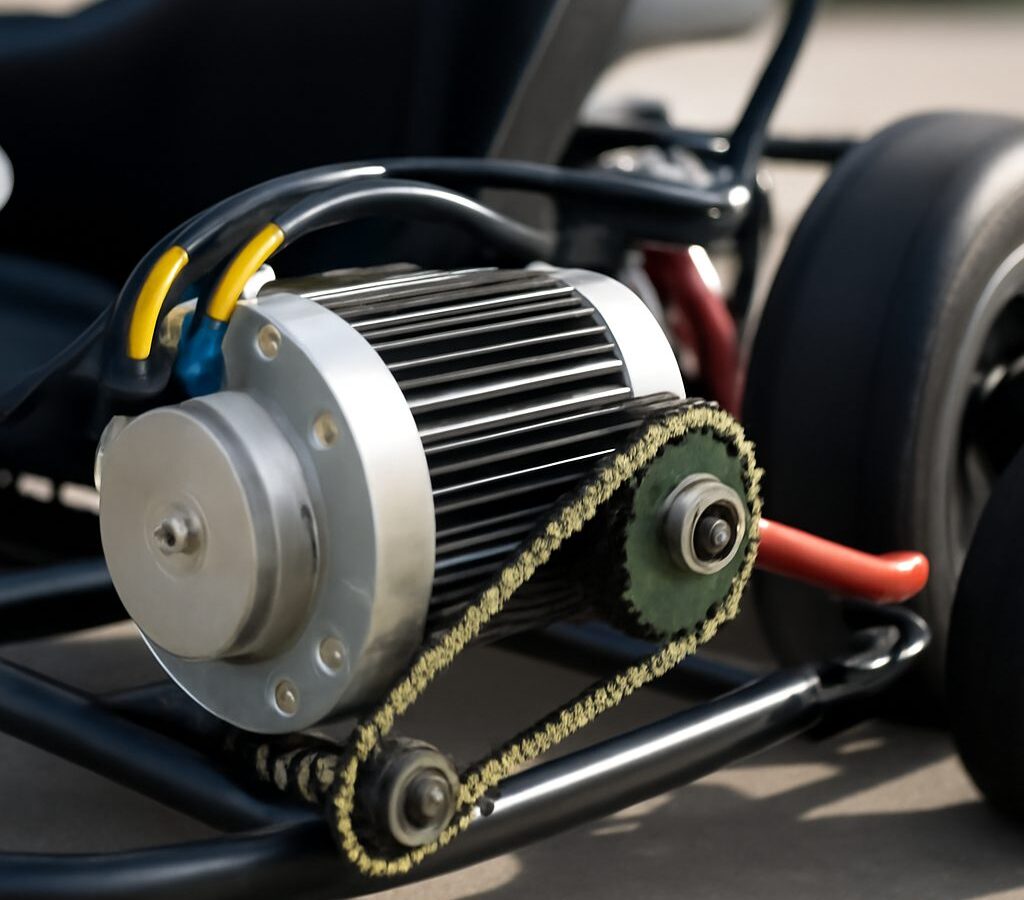
A go kart electric motor turns battery power into the instant, quiet torque that drives your rear axle, and for many DIY builders it is the most rewarding upgrade over a small gas engine. Electric power means no carburetor, no oil changes, and speed you can tune with a controller instead of a wrench. But the motor is only one part of a system that also includes a battery, a speed controller, a throttle, gearing, and wiring rated for the current you will pull. Size that system correctly and you get a smooth, punchy kart. Get it wrong and you end up with an overheating motor, a fried controller, or a kart that struggles up a driveway. This guide covers motor types, sizing, gearing, and safe installation.
Part of our Electric Go-Karts guide — explore the full guide →
What Is a Go-Kart Electric Motor?
A go-kart electric motor is a DC or AC electric machine that converts battery power into rotational force at the axle, replacing the gas engine of a traditional build. It is rated mainly by voltage, continuous power in watts, and RPM at that voltage. On most karts the motor drives a chain or belt through a sprocket or pulley to the rear axle, so final speed and torque depend as much on gearing as on the motor itself.
The motor never works alone. It needs four companions:
- A battery pack that supplies voltage and current.
- A speed controller (often called an ESC or motor controller) that meters power to the motor, limits current, and protects against overload.
- A throttle, usually a hall-effect foot pedal or twist grip, that tells the controller how much power to deliver.
- A drivetrain of chain, sprockets, or belt that carries torque to the axle.
Many controllers also provide reverse, adjustable speed limits, and regenerative braking. Motor, battery, and controller must share the same voltage, and the controller must handle the motor’s current draw. A mismatched trio either underperforms or burns out.
For the wider picture of how electric karts compare with gas, see our electric go-karts complete guide.
Types of Go-Kart Electric Motors
A handful of motor families dominate kart builds, and each has a clear sweet spot.
Brushed DC motors are the simplest and cheapest. They run on a basic controller, are easy to wire, and are forgiving for a first build. The trade-off is that the brushes wear and need periodic replacement, the motor runs hotter, and efficiency is lower, so range and top speed suffer for a given battery. They suit budget builds and kids’ karts.
Brushless DC (BLDC) motors are the modern standard for performance builds. They are more efficient, run cooler, last much longer, and pack more power into less weight. They need a matched brushless controller and correct phase and sensor wiring, which raises cost and complexity slightly. Our brushless motor go-kart guide covers sensored versus sensorless setups.
Hub motors build the motor into the wheel, eliminating the chain and sprockets. They are clean, compact, and quiet, but gearing is fixed, servicing is harder, and the extra weight at the wheel hurts handling on a performance kart. They suit cruisers more than fast builds.
AC induction motors show up on high-power custom builds. They are robust and need very little maintenance, but they cost more and require a matching AC controller.
Most frame-mounted brushed and brushless motors are used as chain-drive (mid-drive) setups: the motor bolts to the frame and drives the axle through a chain, which lets you tune gearing for torque or top speed.
Best Electric Motor for Go-Karts: our top 3 picks
| Product | Best for | Key features | Price | Buy |
|---|---|---|---|---|
| doinal KR5V 72V 5000W kit | Best overall |
| $379.90as of Nov 17, 2026 1:36 pm EST | Buy now →Check current price |
| doinal 72V 3000W kit | Best 3kW adult conversion |
| $279.90as of Nov 17, 2026 1:36 pm EST | Buy now →Check current price |
| doinal 48V 2000W kit | Best 48V build |
| $259.90as of Nov 17, 2026 1:36 pm EST | Buy now →Check current price |


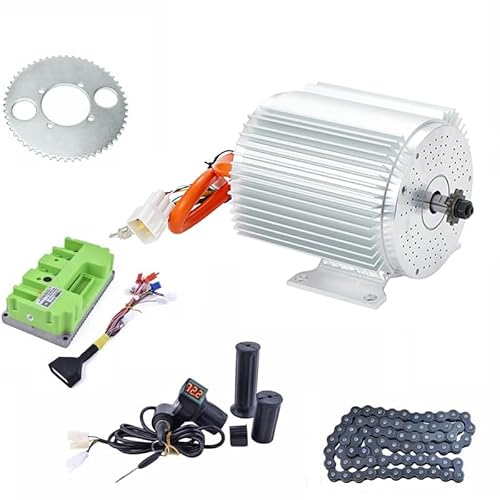
Prices are Amazon’s listed prices as of the date and time shown and are subject to change; the price on Amazon at the time of purchase applies. As an Amazon Associate we earn from qualifying purchases.
Go-Kart Electric Motor Types Compared
Power and price figures are typical ranges for the motor alone, in USD.
| Motor Type | Typical Power | Efficiency | Maintenance | Gearing Flexibility | Typical Motor Cost | Best For |
|---|---|---|---|---|---|---|
| Brushed DC | 500-1,500 W | Low to medium | Brushes wear | Good (chain) | $40-$150 | Budget and kids’ builds |
| Brushless DC | 1,000-5,000 W+ | High | Very low | Good (chain) | $120-$600 | Performance and adult builds |
| Hub motor | 500-2,000 W | High | Low, no chain | Limited (fixed) | $150-$450 | Quiet cruisers |
| AC induction | 3,000 W+ | High | Very low | Good (chain or belt) | Highest | High-power custom builds |
How to Choose and Size a Motor
Start with your goal and work backward. Decide on rider weight, terrain, and target top speed, then size voltage, power, and gearing to match. A light child on flat ground needs far less power than a heavy adult on hills. An undersized motor is slow and overheats, while an oversized one drains the battery quickly and can overpower a light frame.
Voltage
As a rough guide, 24 V and 36 V systems suit light and youth karts, 48 V is the popular adult middle ground, and 60 V to 72 V systems are for serious speed. Higher voltage makes the same power with less current, which keeps wiring, connectors, and controllers manageable. Our guides to 48V electric go-karts and other voltage tiers explain the trade-offs.
Power
Typical ranges are roughly 500 to 1,000 W for kids’ karts, 1,000 to 2,000 W for teens and light adults, 2,000 to 3,000 W for a brisk adult recreational kart, and around 5,000 W and up for genuinely fast builds. Focus on the continuous rating, not the peak. A motor can surge above its continuous rating for short bursts, but sustained running above it causes overheating.
Gearing
Gearing ties the system together. Electric motors spin fast, so chain-drive karts commonly run substantial reduction, often somewhere around 6:1 to 10:1 depending on motor RPM and wheel size. More reduction, from a smaller motor sprocket or larger axle sprocket, means stronger acceleration and hill climbing but a lower top speed. Less reduction raises top speed but loads the motor harder from a stop. Use our go-kart sprocket calculator to estimate speed for a given motor RPM, ratio, and tire size.
Controller Match
The controller must be rated for your system voltage and for at least the motor’s continuous current, with headroom for peaks. Brushed motors need a brushed controller, and brushless motors need a matched brushless controller. An undersized controller will cut out or fail under load.
Battery
The battery must deliver the current the motor demands without excessive voltage sag. Lithium packs (LiFePO4 or lithium-ion) deliver current more consistently than lead-acid and save significant weight, which improves handling and range. Lead-acid is cheaper upfront but heavy. See our guide to batteries for electric go-karts for capacity and chemistry choices.
Converting a Gas Kart to Electric
Most gas karts can be converted. Remove the engine, clutch or torque converter, and fuel system, then mount the electric motor, controller, and battery pack, ideally on the same chain line. The usual challenges are finding room and a secure mount for the battery, keeping weight balanced, and matching the gear ratio to the motor’s RPM rather than the old engine’s. A purpose-built go-kart electric conversion kit bundles a matched motor, controller, and throttle, which removes most of the guesswork.
Installation and Wiring Safety
Electric motors are quiet, which makes them deceptively dangerous. A kart that looks switched off can lurch the instant the throttle is bumped.
Fit a master switch and kill switch. Wire in a keyed master switch or contactor plus a separate emergency kill switch within easy reach of the driver. Always disconnect the battery before working on the drivetrain.
Wire for the current, not just the voltage. A 48 V, 3,000 W motor can pull 60 amps or more under load. Use appropriately gauged copper cable, fuse or breaker the main battery lead, and keep connections insulated and strain-relieved so vibration cannot chafe them bare.
Mount the motor on an adjustable plate. A slotted or sliding mount lets you set chain tension correctly. A loose chain jumps off, and an overtight one wears bearings. Align the motor and axle sprockets closely so the chain runs straight.
Guard the chain. Fit a guard over the exposed chain and sprockets to protect fingers and clothing.
Manage heat and water. Place the controller where it gets airflow but is shielded from spray, and give a high-power motor a clear path for cooling air.
Test before riding. Run the whole system on a stand with the rear wheels off the ground, check throttle response and the kill switch, then make the first low-speed run in an open area.
Troubleshooting Common Problems
Overheating usually means the motor is undersized for the load, the gearing asks for too much torque, or airflow is blocked. Add reduction, reduce load, or step up in motor size.
Cutting out under acceleration often points to the controller hitting its current limit or the battery sagging below the controller’s low-voltage cutoff.
Weak top speed can come from too much gear reduction, a low battery state of charge, or a controller speed limit setting.
Pros and Cons
Pros
- Instant torque and smooth power delivery
- Near-silent with no fumes, fuel, or oil changes
- Very low maintenance with brushless designs
- Speed and power easily tuned through the controller
- Suits neighborhood and indoor use
Cons
- Higher upfront cost than a comparable small gas engine
- Range limited by battery capacity and rider weight
- Motor, controller, and battery must be matched precisely
- High-current wiring demands care and proper fusing
- Recharging takes far longer than refueling
Frequently Asked Questions
What size electric motor does a go-kart need?
Is a brushless or brushed motor better for a go-kart?
What battery voltage should I use?
How fast will an electric motor make my go-kart go?
Can I convert my gas go-kart to electric?
Do electric go-kart motors need maintenance?
Why is my electric go-kart motor overheating?
How much torque reaches the rear axle from an electric go-kart motor?
Can you use a 1725 rpm motor on a go-kart?
Do two electric motors make a go-kart faster?
Can I increase the top speed of a slow electric kart?
Final Thoughts
A go kart electric motor turns a DIY frame into a quick, quiet, low-maintenance machine, but only when the motor, battery, controller, and gearing work as one matched system. Size voltage and continuous power to rider weight and speed goals, choose brushless if your budget allows, wire for the real current, and never skip the kill switch and chain guard. When you are ready to compare specific units, see our best electric motor for go-kart roundup.