
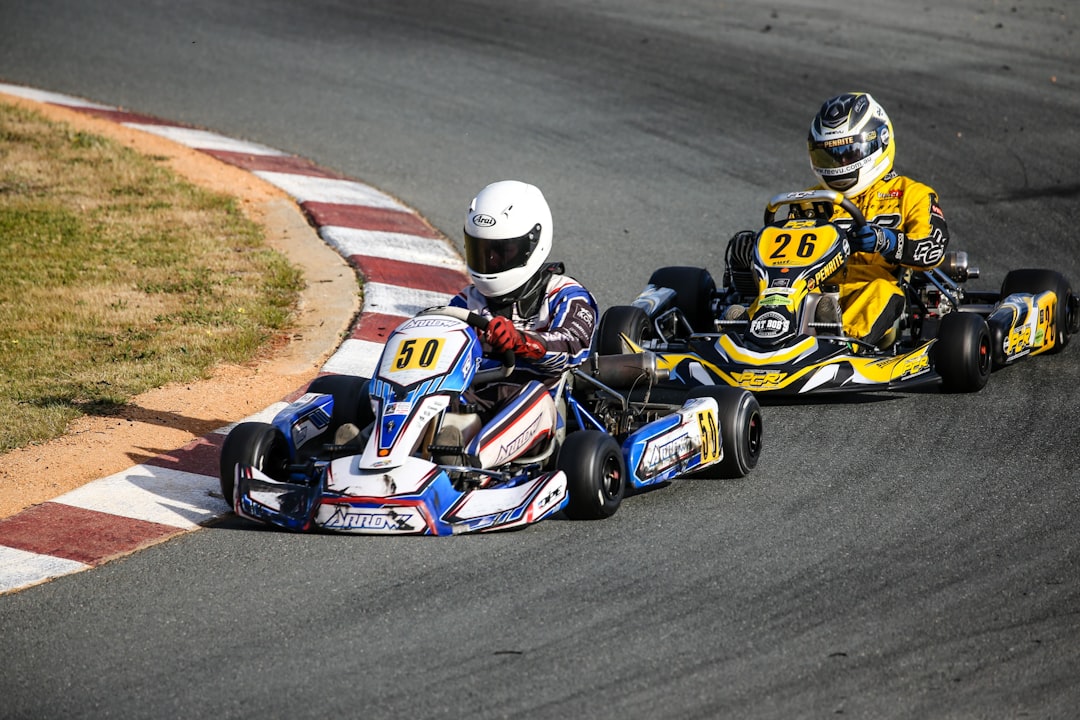
Go-kart steering is a direct mechanical system: the steering wheel turns a column, an arm at the bottom of the column pushes and pulls two tie rods, and the tie rods swing the front spindles left and right. There is no power assist and, on most karts, no steering box or suspension, so the geometry does all the work. That geometry does more than point the wheels. Caster and kingpin inclination lift the chassis as you turn, which unloads the inside rear tire and lets a kart with a locked rear axle get around corners. This guide explains how kart steering works, the main layouts, the geometry terms that matter, and how to adjust and inspect a system safely.
Part of our Go-Kart Parts guide — explore the full guide →
How Go-Kart Steering Works
Follow the path from your hands to the tires:
- Steering wheel: bolted to the top of the column through a hub, sometimes with a quick-release.
- Steering column (shaft): runs down and forward, supported by a bushing or bearing at the top and at the bottom.
- Steering arm or plate: welded or bolted to the bottom of the column. On racing karts it is a plate with several holes for tie-rod attachment.
- Tie rods: two adjustable rods, one to each side, with rod ends (heim joints) or ball joints at each end.
- Spindles: the uprights that carry the front wheels. Each pivots on a kingpin bolt through the frame’s C-shaped mount, and each has a steering arm the tie rod attaches to.
Turn the wheel right, the column rotates, the arm swings, one tie rod pushes, the other pulls, and both spindles pivot so the front wheels steer right. Every connection in that chain is a potential source of play, which is why kart steering can feel razor sharp when fresh and vague when joints wear. For a closer look at the individual parts, see our guides to the go-kart steering spindle and go-kart steering linkage.
Why Kart Steering Is Different From a Car
A car has a differential, suspension, and usually power-assisted rack-and-pinion steering. A sprint kart has none of those. Its rear axle is locked, so both rear wheels turn at the same speed. If both rear tires stayed planted in a corner, the kart would push straight on.
The steering geometry solves this. Because the kingpins are tilted backward (caster) and usually inward (kingpin inclination), turning the wheel makes the spindles move up and down as they pivot. The net effect is that the chassis is lifted on one side, which shifts weight and lets the inside rear tire unload or lift slightly. That is the mechanism that lets karts turn without a differential, and it is why caster and front track width are real tuning tools on racing karts.
Best Go Kart Steering Wheel: our top 3 picks
| Product | Best for | Key features | Price | Buy |
|---|---|---|---|---|
| PRO BAT 300mm Kit | Best overall steering kit |
| $82.99as of Oct 27, 2026 7:02 am EDT | Buy now →Check current price |
| Bryke Racing Quick Release | Best go-kart quick release |
| $42.95as of Oct 27, 2026 7:02 am EDT | Buy now →Check current price |
| NINEFOX 10.5in Wheel | Best replacement wheel |
| $18.99as of Oct 27, 2026 7:02 am EDT | Buy now →Check current price |


Prices are Amazon’s listed prices as of the date and time shown and are subject to change; the price on Amazon at the time of purchase applies. As an Amazon Associate we earn from qualifying purchases.
Types of Go-Kart Steering Layouts
Direct column steering is the standard on sprint karts and most recreational karts. The column’s lower arm connects straight to both tie rods. It is light, simple, and gives the most feedback.
Bell-crank or drag-link steering uses an intermediate lever or link between the column and the tie rods. It appears on longer off-road and homemade frames where the column cannot sit directly between the spindles, and on karts where the seat position forces the column off-center.
Rack-and-pinion steering uses a small gear rack, as on a car. It is common on off-road karts and buggies with suspension, where it helps manage bump steer and kickback over rough ground. It adds weight and parts. Our go-kart rack-and-pinion steering guide covers when it makes sense.
Go-Kart Steering Layouts Compared
| Layout | Complexity | Feedback | Typical Use | Main Drawback |
|---|---|---|---|---|
| Direct column | Low | Very direct | Sprint, rental, and most recreational karts | Kickback over rough ground |
| Bell-crank / drag link | Medium | Good | Long or unusual frames, some off-road builds | More joints that can develop play |
| Rack-and-pinion | Higher | Moderate, damped | Off-road karts and buggies with suspension | Heavier, more parts to maintain |
Go-Kart Steering Geometry Explained
A few terms explain almost everything about how a kart feels on turn-in and mid-corner.
Ackermann
In a turn, the inside front wheel follows a tighter circle than the outside one, so it should steer at a slightly sharper angle. Ackermann geometry achieves this through the angle of the spindle arms and where the tie rods attach. Racing karts let you change the effective Ackermann by moving tie rods between holes on the steering plate or spindle arm, which changes how aggressive turn-in feels.
Toe
Toe is whether the front wheels point slightly inward (toe-in) or outward (toe-out) when the steering is straight. Most karts run close to zero or a small amount of toe-out, which sharpens initial response. Too much in either direction scrubs the tires, slows the kart on straights, and makes it wander. Chassis manufacturers publish starting values, and those are the right place to begin.
Caster
Caster is the rearward tilt of the kingpin. More caster increases steering weight and the chassis-lifting effect described above, adding front grip and rear rotation. Less caster lightens the steering and reduces weight jacking. Racing karts often adjust caster with eccentric inserts in the kingpin mounts; on most recreational karts it is fixed.
Camber
Camber is the inward or outward tilt of the front tire viewed from the front. It affects how the tire contacts the track mid-corner. Like caster, it is adjustable on racing karts and fixed on most recreational karts.
Steering ratio
How far the wheels turn per degree of steering input. Moving the tie rods to a hole farther from the column center on the steering plate makes steering quicker and heavier; moving them closer makes it slower and lighter. Wheel diameter also changes effort and feel.
Steering Wheel Size and Driver Fit
Adult sprint wheels are commonly around 12 to 13.5 inches (roughly 300 to 340 mm) in diameter. A larger wheel gives more leverage and calmer response; a smaller wheel is quicker but heavier to turn. Kids’ karts usually use smaller wheels sized to the driver’s hands and reach.
Fit matters as much as size. With hands at roughly the quarter-to-three position, your elbows should keep a comfortable bend. If you are straining to reach or cramped against the wheel, adjust the column angle, the seat position, or the column length before changing anything else.
How to Adjust Go-Kart Steering
Always start from the chassis maker’s recommended settings, and change one thing at a time.
- Center the steering. Put the wheel straight and lock it in place, or check that the steering arm points straight back.
- Check for play. Wiggle each tie-rod end, spindle, and the column. Fix any looseness before you measure.
- Measure toe. With the kart on a flat surface, measure across the front of the tires and across the back at hub height. The difference is your toe. Alignment bars or a laser tool give more repeatable results.
- Adjust the tie rods. Loosen the jam nuts, turn each rod equally to keep the steering wheel centered, set toe, then retighten.
- Check full lock. Turn fully left and right. Nothing should touch the frame, pedals, bodywork, or the driver’s legs.
Safety and Inspection
Steering is a life-safety system. A failed tie rod or spindle removes all directional control. Treat these as non-negotiable:
- Use rod ends and hardware rated for the job, with lock nuts or castle nuts and cotter pins.
- Make sure rod-end threads are engaged deeply enough; check the manufacturer’s minimum.
- Inspect for play, cracks, and bent tie rods before each session and after any impact.
- Never straighten and reuse a bent tie rod, spindle, or steering column. Replace it.
- Have steering welds on homemade frames inspected by someone experienced.
Steering problems often show up as handling problems. A kart that wanders, pulls, or feels twitchy usually has excess toe, worn joints, a loose column bushing, or a bent part.
Pros and Cons of Go-Kart Steering
The direct design is a big part of why karts feel the way they do, but it has costs.
Pros
- Simple mechanical system that is easy to inspect and repair
- Very direct feedback from the front tires
- Highly tunable on racing chassis through toe, caster, camber, and Ackermann
- Parts are inexpensive and widely available
Cons
- No power assist, so steering can be heavy
- Worn joints quickly make the kart vague or twitchy
- Direct column steering transmits kickback on rough ground
- Poor geometry causes tire scrub and unpredictable handling
Frequently Asked Questions
How does go-kart steering work?
Why is go-kart steering so heavy?
What toe setting should a go-kart have?
Why does my go-kart pull to one side?
Do go-karts have power steering?
Do go-karts use rack-and-pinion steering?
How often should I check my go-kart steering?
Final Thoughts
Good go-kart steering comes from tight joints and sensible geometry more than from expensive parts. Learn what toe, caster, and Ackermann do, start from the maker’s settings, and inspect the system every time you drive. If you are replacing parts or building from scratch, our go-kart steering kit guide covers choosing and installing a matched set, the go-kart parts hub covers the rest of the kart, and the best go-kart steering wheel roundup helps you pick the wheel itself.