

A 20 hp go kart engine roughly triples the output of the common 6.5 hp 212cc yard-kart engine. That jump changes everything downstream of the crankshaft. You can reach about 20 hp in three main ways: a stock horizontal-shaft V-twin in roughly the 600cc to 700cc range, a big 420cc to 460cc single with performance upgrades, or a 125cc two-stroke racing engine. Each route trades cost, weight, and complexity differently. Whichever you choose, the clutch, chain, axle, brakes, and frame all have to be built for the power. This guide covers the options, how fast a 20 hp kart typically goes, what the build costs, and the hardware it needs to stay in one piece.
Part of our Go-Kart Engines & Drivetrain guide — explore the full guide →
What Counts as a 20 HP Go-Kart Engine?
Advertised horsepower in the small-engine world is not always measured the same way. Some manufacturers quote gross output under ideal test conditions, others quote figures closer to what the engine delivers in use, and listings for clone engines often round up. Treat “20 hp” as a class rather than a precise number, and check the manufacturer’s spec sheet for the engine you’re considering.
With that caveat, three engine families sit in or near this tier:
Horizontal-shaft V-twins. Air-cooled twins built for mowers, pressure washers, and generators, commonly rated around the low 20s of horsepower stock. They offer easy torque, electric start, and no tuning required. Our V-twin go-kart engine guide covers them in depth.
Modified big singles. Horizontal-shaft singles of about 420cc to 460cc are usually rated in the low teens of horsepower stock. With a performance cam, a larger carburetor, a free-flowing exhaust, and governor removal, builders report figures approaching or reaching 20 hp. Results vary with the parts used and the quality of the work.
125cc two-stroke racing engines. Track engines such as TaG (touch-and-go) and shifter units can produce this much power or more at a fraction of the weight. They are racing engines with racing maintenance schedules, and they belong on a racing chassis.
For a broader overview of displacement tiers and engine types, see our go-kart engine guide.
20 HP Go-Kart Engine Options Compared
The table compares engine categories, not specific products. Weights and costs are approximate USD ranges and vary by brand, condition, and what is included.
| Option | Typical displacement | Power route | Relative weight | Approx. cost |
|---|---|---|---|---|
| Stock V-twin | About 600cc to 700cc | Rated near 20 hp out of the box | Heaviest and widest | $700 to $2,500 depending on brand |
| Modified big single | 420cc to 460cc | Cam, carb, exhaust, governor work | Moderate | $800 to $1,400 built |
| 125cc two-stroke racing | 125cc | Racing design, high RPM | Lightest | Several thousand new |
| Stock big single (reference) | 420cc to 460cc | Low teens of hp | Moderate | $350 to $700 |
Best Go Kart Engine: our top 3 picks
| Product | Best for | Key features | Price | Buy |
|---|---|---|---|---|
| maXpeedingrods MXR212R | Best overall 212cc |
| $149.99as of Oct 27, 2026 4:11 am EDT | Buy now →Check current price |
| maXpeedingrods MXR212E | Best electric start |
| $209.99as of Oct 27, 2026 4:11 am EDT | Buy now →Check current price |
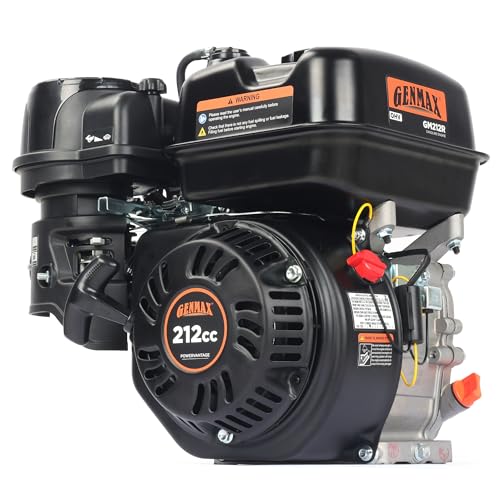
| GENMAX GM212R | Best support plan |
| $169.99as of Oct 27, 2026 4:11 am EDT | Buy now →Check current price |


Prices are Amazon’s listed prices as of the date and time shown and are subject to change; the price on Amazon at the time of purchase applies. As an Amazon Associate we earn from qualifying purchases.
How Fast Is a 20 HP Go-Kart?
A 20 hp kart is fast, but you can’t give it a single top speed. Gearing, tire diameter, total weight with the driver, aerodynamics, and the surface all matter as much as horsepower. A light kart geared tall on smooth pavement will go far faster than a heavy two-seat off-road kart geared for hills.
For most builders, the more noticeable change is acceleration. Compared with a 6.5 hp kart, 20 hp spins the rear tires easily on loose ground, lifts the inside front wheel out of corners, and reaches speeds where cheap components and poor brakes become dangerous. Gear for the space you actually have. A tall top speed is useless on a short track or a backyard loop. Our guide to how fast go-karts go puts speeds across the whole karting spectrum in context.
The Drivetrain a 20 HP Engine Demands
This is where most 20 hp builds succeed or fail. Components that last for years behind a 6.5 hp engine wear out quickly or break at three times the power.
Clutch or torque converter. Choose a unit rated by its manufacturer for the power and torque of your engine and with the right bore for its crankshaft (larger engines often use a 1-inch shaft). Undersized clutches slip, glaze, and overheat. Undersized torque converters burn belts. A torque converter suits off-road and two-seat karts that need low-speed pulling power. A heavy-duty centrifugal clutch suits lighter karts on hard surfaces. Our torque converter vs clutch guide explains the trade-offs.
Chain and sprockets. The #35 chain used on small yard karts is generally too light here. Most builders step up to #40, #41, or #420 chain with matching sprockets, keep alignment exact, and check tension often.
Axle and hubs. Use a live axle of adequate diameter (1 inch or larger is common on builds in this class), proper bearing hangers, and keyed hubs. Light bolt-on wheel setups from budget yard karts are not built for this torque.
Brakes. Fit hydraulic disc brakes. Mechanical band or scrub brakes are not adequate at the speeds and weights a 20 hp kart reaches. See our guide to go-kart hydraulic brake kits for what a good system includes.
Chassis Requirements
Put 20 hp only on a frame designed for it. That means welded steel tubing with adequate wall thickness, gussets at the engine mount and axle bearing hangers, a seat with real side support, and roll protection on off-road karts. Light minibike-grade frames tend to crack at the welds under this torque.
Engine choice also affects the frame. A V-twin is much wider and heavier than a single, and it often needs a wider engine bay or offset mounts. A modified single fits most standard frames built for horizontal-shaft engines. A racing two-stroke needs a racing kart chassis, not a yard-kart frame.
Building a Modified Single Safely
If you’re tuning a big single toward 20 hp, safety parts come first:
Billet rod and flywheel. Stock cast connecting rods and flywheels are designed for governed RPM. Before you raise the rev limit, replace them with billet parts made for higher RPM. A flywheel that fails at speed is extremely dangerous.
Valve springs. Stronger springs prevent valve float at higher RPM, especially with a performance cam.
Keep the governor until the internals are done. Removing the governor on a stock engine with cast parts is a common cause of engine failure.
Tuning. A larger carburetor needs jetting for your conditions. A lean engine at high RPM can overheat and seize.
Our guide to the Predator go-kart engine covers the most popular horizontal-shaft family in more detail.
What a 20 HP Build Costs
The engine is usually less than half the total. A typical budget includes:
Engine: roughly $700 to $2,500 for a V-twin depending on brand, or $800 to $1,400 for a big single including performance parts.
Clutch or torque converter: often $150 to $400 for a unit rated for this power.
Axle, hubs, bearings, chain, sprockets: commonly $200 to $500.
Hydraulic brakes: typically $150 to $400.
Frame: from a few hundred dollars for a used heavy-duty frame to well over $1,000 for a new one built for this power.
Realistic all-in costs for a home-built 20 hp kart often land between $2,000 and $5,000, depending on how much fabrication you do yourself.
Safety Gear and Maintenance
At this power level, safety equipment is essential. Wear a full-face helmet that meets a recognized standard, gloves, sturdy shoes, and long sleeves. Off-road and two-seat karts should have seat belts and roll protection. Fit a kill switch the driver can reach, a chain guard, and a heat shield between the exhaust and the driver.
Maintenance is more demanding than on a 6.5 hp kart. Check chain tension and sprocket wear before every session, inspect the clutch or torque converter belt regularly, change the oil at the manufacturer’s intervals, and check the brake fluid and pads. On modified engines, check valve clearance more often.
Pros and Cons
Twenty horsepower brings a big step up in fun, and in responsibility.
Pros
- Strong acceleration and performance on a home-build budget
- V-twins reach this class without tuning
- Modified singles keep size and cost down
- Healthy aftermarket for clutches, converters, axles, and brakes
Cons
- Wears out or breaks undersized clutches, chains, and axles
- V-twins are heavy and too wide for many frames
- Modified singles need billet internals for safe RPM
- Requires a strong chassis and hydraulic brakes
Frequently Asked Questions
How fast will a 20 hp go-kart go?
What engine makes 20 hp for a go-kart?
What clutch do I need for a 20 hp engine?
Can I put a 20 hp engine on a regular yard kart?
Is a V-twin or a modified single better for 20 hp?
Do I need to remove the governor to get 20 hp from a single?
Final Thoughts
A 20 hp go kart engine turns a kart into a genuinely fast machine, as long as every part behind it is upgraded to match. Pick a stock V-twin for simplicity, a built big single for packaging and cost, or a racing two-stroke if the track is your goal. Size the clutch or torque converter correctly, and put it all on a strong frame with hydraulic brakes. To compare specific engines, see our roundup of the best go-kart engines.