
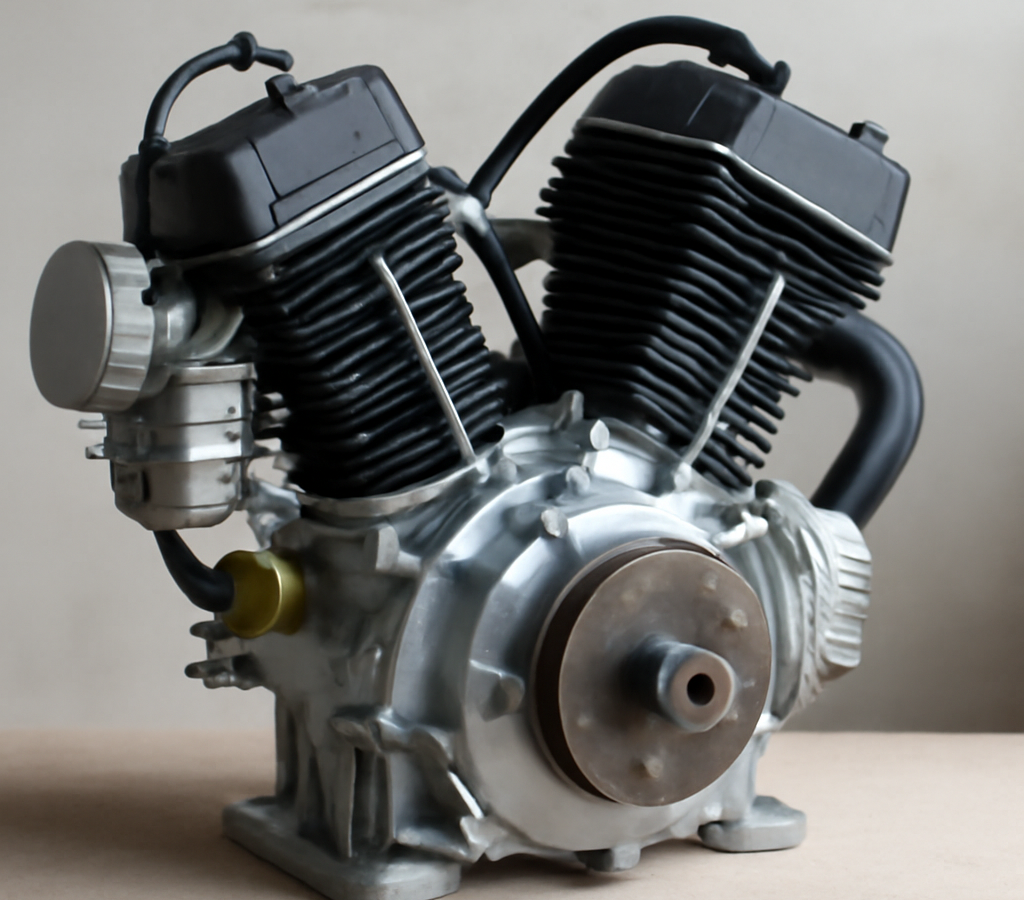
A v twin go kart engine is the biggest, torquiest four-stroke you can realistically bolt to a kart frame: 670cc-class twins making 22–25 hp and enough low-end grunt to spin a live axle at will. Predator, Honda-clone, and small-engine V-twins built for generators and mowers have become the go-to swap for heavy off-road karts, two-seaters, and drift builds — but they are wide, heavy, and torque-rich in ways a single-cylinder kart was never designed for. This guide covers what these engines actually deliver, what 22+ hp demands from your chassis, how to size the torque converter, and where a V-twin genuinely belongs.
What Is a V Twin Go-Kart Engine?
The engines in question are horizontal-shaft, air-cooled V-twins in the 570–708cc range — the Predator 670 (~22 hp) is the icon, alongside Honda GX630/GX690-class twins and their clones (roughly 20–25 hp, with the GX690 rated around 25 hp). They were engineered for pressure washers, generators, and zero-turn mowers, which is exactly why they suit karts: a 1-inch keyed horizontal shaft, simple carburetion, electric start, and torque from just above idle.
Compared to the single-cylinder 212s and 420s most builders know, a V-twin roughly doubles the power and torque — 30+ lb-ft against a 212’s ~8 lb-ft — while adding 80–100 lbs and roughly twice the physical width. That combination is the entire story of V-twin builds: enormous, accessible grunt that stresses every component downstream of the crankshaft. If you are stepping up from a big single, our 20 hp go-kart engine guide covers the class immediately below this one.
Types of V Twin Kart Builds
V-twin karts cluster into four honest use cases.
Off-road and mud karts. The natural home. Heavy frames, big tires, and terrain that eats momentum reward torque over rpm. A 670 pulls a 600-lb off-road kart with two adults up grades that would stall a 212.
Two-seater yard karts. Passenger weight doubles the load on the drivetrain; a V-twin keeps performance strong instead of adequate. This is the most popular family build.
Drift and grass karts. Instant torque breaks rear tires loose on demand, which is why V-twin drift karts dominate the genre. Simple, spectacular, and hard on axles.
Speed builds. Geared tall on a long enough surface, a V-twin kart can exceed 60 mph — but a light sprint-style frame with 100 lbs of engine hanging off the back is doing something it was never designed for. If outright speed is the goal, the two-stroke ladder does it better; see the neighboring big-bore territory in our 500cc go-kart engine guide for how this class compares.
V Twin Engines Compared
| Engine | Displacement | Rated power | Approx. weight | Typical price | Best for |
|---|---|---|---|---|---|
| Predator 670 | 670cc | ~22 hp | ~99 lbs | $700–$900 | Budget off-road and drift builds |
| Honda GX630 class | 688cc | ~20.8 hp | ~97 lbs | $1,500–$2,200 | Reliability-first builds |
| Honda GX690 class | 688cc | ~25 hp | ~99 lbs | $1,800–$2,500 | Maximum four-stroke grunt |
| Generic 670–708cc clones | 670–708cc | 20–25 hp | 95–105 lbs | $600–$1,000 | Budget builds, parts-swap projects |
| Predator 212 (reference) | 212cc | 6.5 hp | ~38 lbs | $150–$200 | Standard single-seat yard karts |
Manufacturer ratings vary by spec revision — verify the current rating on the engine you actually buy rather than trusting listings.
Cost and Considerations: What 22+ HP Demands
Chassis. A V-twin belongs on 1.25-inch, 0.120-wall (or heavier) tube frames purpose-built for the weight. Bolting one to a frame designed for a 212 cracks welds and worse. Engine plates need to be 1/4-inch steel or thick aluminum, and the extra ~100 lbs sits high and rearward, so plan the wheelbase and seat position around it.
Axle and drivetrain. This torque snaps 3/4-inch axles. Run a 1-inch or 1.25-inch live axle with matching hubs, and step up to #40/#41 chain minimum (many builders run #50) with a 40-tooth-plus sprocket sized for torque multiplication rather than top speed.
Torque converter sizing. The 3/4-inch Comet 30-series units that serve 212s are undersized here. At 670-class torque you want a Comet 40/44-series-style converter rated for 8–25 hp with a 1-inch driver bore, or a heavy-duty clutch alternative. An undersized converter slips, glazes, and burns belts within hours at this power level.
Brakes and mounting width. Hydraulic disc brakes are mandatory at the speeds and weights involved — mechanical band brakes are a 212 solution. And measure twice: a V-twin is roughly 18–20 inches wide, so rear-engine bays sized for singles often need frame surgery, offset mounts, or relocated seat rails to clear the cylinders and exhaust.
Budget. A realistic all-in V-twin build — engine, converter, 1-inch axle kit, hydraulic brakes, steel — lands between $2,500 and $5,000 even with a donor frame.
How to Choose: Is a V Twin Right for Your Kart?
Choose a V-twin when weight and terrain are the problem: two-seaters, off-road karts, tow duty, mud, hills, and drift builds where torque is the feature. Skip it when speed on smooth ground is the goal — a built single or a two-stroke delivers more speed per pound and per dollar, and no sprint kart benefits from a 100-lb engine.
Between engines: the Predator 670 wins on price and community knowledge, Honda-class twins win on longevity and dealer parts. Buy the engine after you have confirmed frame width, axle spec, and converter budget — the engine is only about a third of the true cost. And at 60-mph-capable weights, treat restraints and protection as part of the build, not accessories; our go-kart seat belts guide covers harness choices for heavy off-road karts.
Pros and Cons
The V-twin is a magnificent engine in the right kart and a liability in the wrong one.
Pros
- 22–25 hp and 30+ lb-ft from a cheap, simple four-stroke
- Effortless torque for two-seaters, hills, mud, and towing
- Electric start and generator-grade reliability
- Predator 670 pricing makes big power affordable
- Huge aftermarket of mounts, converters, and axle kits
Cons
- Adds roughly 100 lbs high and rearward on the frame
- Nearly twice the width of a single, forcing mounting surgery
- Demands 1-inch axle, heavy chain, and hydraulic brakes
- Oversized converter or clutch adds real cost
- Wrong tool for sprint karts and light speed builds
Frequently Asked Questions
How fast will a V-twin go-kart go?
How much horsepower does a Predator 670 have?
What torque converter do I need for a V-twin kart engine?
Can I put a V-twin on a regular go-kart frame?
Is a V-twin better than a Predator 212 for a go-kart?
How much does a V-twin go-kart build cost?
Final Thoughts
A v twin go kart engine is the right answer to a specific question: how do you move a heavy, two-seat, off-road, or drift kart with authority on a four-stroke budget? Rated honestly at 22–25 hp with torque no single can match, the 670-class twin rewards builders who respect what that torque demands — a real frame, a 1-inch axle, a properly sized converter, and hydraulic brakes. Keep it out of sprint karts, build the chassis before the horsepower, and compare the class above and below in our 500cc engine guide and 20 hp engine guide before you commit.