
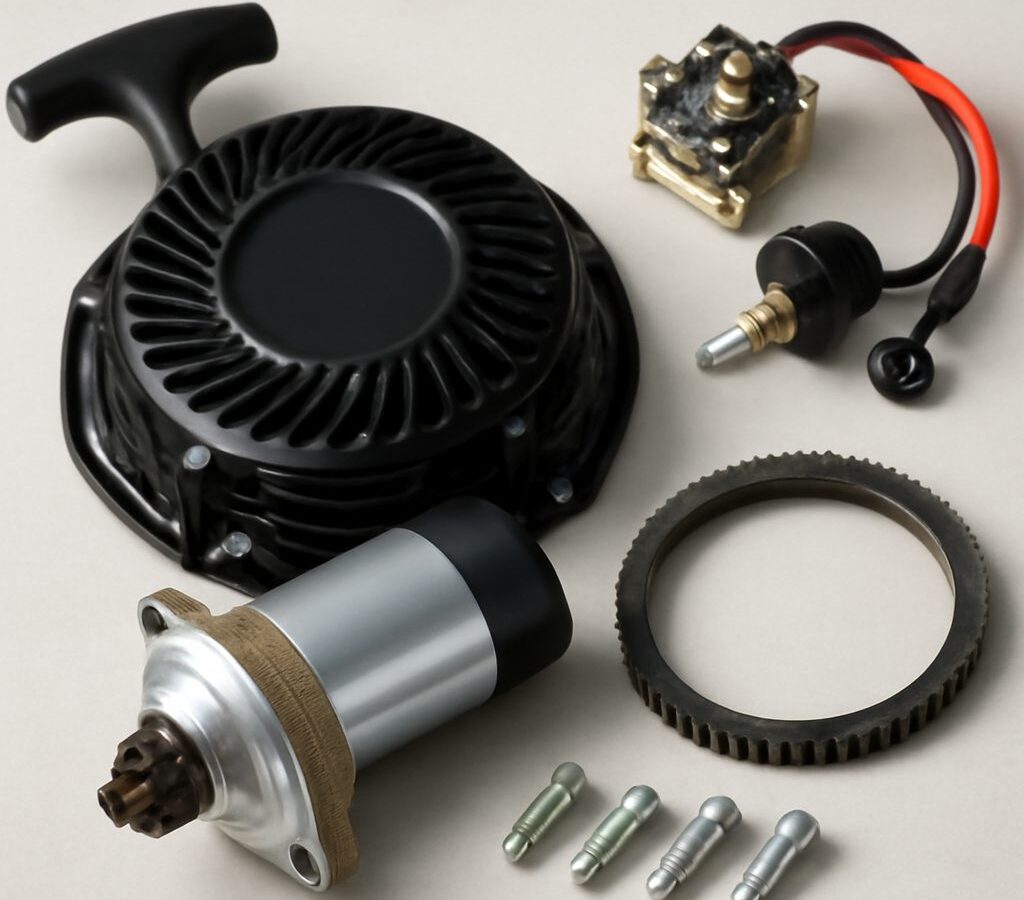
A Predator 212 electric start kit converts Harbor Freight’s pull-start 212cc engine to push-button or key starting. A complete kit adds a 12-volt starter motor, a flywheel with a ring gear (or a ring gear for your existing flywheel), a solenoid, a switch, wiring, and mounting brackets. You usually supply the battery. The conversion suits kids, older drivers, anyone with a sore shoulder, and built engines that are hard to pull over. Expect roughly $80–$180 for the kit and $30–$80 more for a battery and charger. This guide covers what a kit includes, fitment checks, wiring, charging, costs, safety, and how to choose.
Part of our Predator 212 & Clone Engines guide — explore the full guide →
What Is a Predator 212 Electric Start Kit?
From the factory, the Predator 212 starts with a recoil pull cord. There is no starter motor, no ring gear for one to engage, and no charging system. An electric start kit adds those missing parts so a small motor can spin the crankshaft when you press a button or turn a key.
The 212 follows the Honda GX200 layout, so kits are widely sold for that engine pattern. That does not mean every kit fits every 212. Flywheel design, mounting points, and cover shapes differ between versions, so fitment is the single most important thing to check.
If you are still planning your build, compare this upgrade with buying an engine that has electric start from the factory. Our electric start go-kart engine guide covers that route.
What Comes in a Kit
Starter motor. A compact 12-volt DC motor with a small gear that engages the flywheel ring gear while cranking, then retracts.
Flywheel or ring gear. Many kits include a replacement flywheel with a toothed ring gear. Others supply a ring gear that bolts to a compatible flywheel. If neither is included, your engine must already have one.
Solenoid. A heavy-duty relay that switches the high current the starter draws. Your key or button only triggers the solenoid; the solenoid feeds the starter.
Switch and wiring. A key switch or push button, plus cables and connectors. Quality varies a lot between kits.
Brackets and hardware. Plates and bolts to mount the starter in the right position relative to the ring gear.
Battery (usually not included). A small 12-volt battery, typically a sealed lead-acid or lithium powersports type. Size it to the starter’s draw and the kit maker’s recommendation.
Best Predator 212 Upgrades: our top 3 picks
| Product | Best for | Key features | Price | Buy |
|---|---|---|---|---|
| CILOYU Stage 1 Kit | Best overall Stage 1 kit |
| $40.49as of Nov 17, 2026 8:04 am EST | Buy now →Check current price |
| YOXUFA 212 Exhaust Header | Best exhaust header |
| $15.99as of Nov 17, 2026 8:04 am EST | Buy now →Check current price |
| WnSEu Billet Flywheel | Best billet flywheel, non-hemi |
| $109.99as of Nov 17, 2026 8:04 am EST | Buy now →Check current price |


Prices are Amazon’s listed prices as of the date and time shown and are subject to change; the price on Amazon at the time of purchase applies. As an Amazon Associate we earn from qualifying purchases.
Electric Start Kit Types Compared
| Option | Flywheel or ring gear | Charging | Best for | Typical cost |
|---|---|---|---|---|
| Complete conversion kit | Included | Usually none | Stock pull-start 212s | $100–$180 |
| Starter-only kit | Not included | None | Engines that already have a ring gear | $40–$90 |
| Kit with charging coil | Included | Charges while running | Long sessions, lights, accessories | $130–$220 |
| Factory electric-start engine | Built in | Varies by model | New builds that want it from the crate | Engine price |
Prices are typical US ranges and change often. Battery and charger are extra in most cases.
Fitment Checks Before You Buy
Engine version. Confirm whether you have a hemi or non-hemi 212. Flywheels, covers, and starter brackets can differ. Our hemi vs non-hemi guide shows how to identify yours.
Flywheel type. If you run, or plan to run, an aftermarket billet flywheel, check that a ring gear version exists for it. Many lightweight billet flywheels are made without one.
Clearance. The starter adds width on one side of the engine. Check that it clears the frame, engine mount, clutch or torque converter, and fuel tank.
Recoil. Some kits keep the pull start as a backup; others remove it. Keeping a backup is useful when the battery is flat.
How to Install a Predator 212 Electric Start Kit
Most home builders can fit a kit in an afternoon with basic tools and a flywheel puller. Always follow the kit’s instructions over general advice.
- Make it safe. Let the engine cool, remove the spark plug wire, and drain or shut off fuel.
- Remove the shroud and recoil. Take off the fan shroud and pull-start assembly.
- Swap the flywheel if required. Remove the flywheel nut, use a proper puller, then fit the new flywheel with the key seated correctly. A sheared or misaligned key throws off ignition timing. Tighten the nut to the specification in the manual or kit.
- Mount the starter. Fit the bracket and starter so the gear meshes cleanly with the ring gear without binding.
- Wire it up. Run a heavy cable from battery positive to the solenoid, then to the starter. Connect the switch to the solenoid trigger, and run a solid ground from the battery to the engine block. Add an inline fuse on the switch circuit.
- Test. Reconnect the plug wire, check that the kill switch still stops the engine, then try a start.
Mount the battery and solenoid away from exhaust heat and secure all wiring away from moving parts. If the starter clicks but does not spin, check the ground and battery charge before blaming the kit; loose or corroded grounds are the most common fault.
Charging the Battery
The stock 212 has no charging system, so a basic kit draws down the battery with every start. For short sessions and occasional use, a smart charger or battery maintainer between rides is enough.
If you run long sessions, ride far from a plug, or add lights, look for a kit with a charging coil and a regulator-rectifier, or add one separately. Never connect an unregulated coil straight to a battery, because overcharging damages it.
Lithium batteries save weight but need a charger designed for lithium chemistry. Sealed lead-acid is cheaper and more forgiving. Store the battery charged and disconnect it over winter.
Cost of Adding Electric Start
A complete kit typically runs $100–$180, and a starter-only kit less. Add a battery at roughly $30–$70 and a maintainer at $20–$50 if you do not already own one. Cable, terminals, a fuse, and a battery box add a little more.
All in, a clean conversion usually lands somewhere around $150–$280. That is far more than a replacement recoil, so the real question is whether push-button starting is worth it for the people driving the kart. For other bolt-ons, see the best Predator 212 upgrades roundup.
Safety Considerations
A starter makes the engine easier to start, which is good for convenience and something to manage with kids. A removable key gives you control over who can start the kart.
Fuel and sparks do not mix. Keep the battery and solenoid away from the fuel tank and lines, cover the positive terminal, and fuse the circuit. Disconnect the battery before working on the engine.
Some electric start kits are paired with heavier flywheels, while high-RPM builds often use lightweight billet flywheels for strength. If you have removed the governor or run the engine at high speed, the flywheel and connecting rod must be rated for it; a cast flywheel or stock rod pushed past its limits can fail violently. Choose a ring-gear flywheel that is suitable for your engine speed, and read our governor removal guide for the bigger picture.
Maintenance and Troubleshooting
Check battery voltage and terminal tightness regularly, and clean any corrosion. Inspect cables for chafing where they pass the frame or engine. Keep the starter gear and ring gear free of dirt, and look for chipped teeth if you hear grinding.
Crank in short bursts of a few seconds, with a pause between attempts, so the starter does not overheat. If the engine cranks but will not fire, the problem is fuel or spark, not the starter, so check the choke, fuel supply, and spark plug as you would on a pull-start engine.
How to Choose the Right Kit
Start with fitment: engine version, flywheel compatibility, and frame clearance. Next, decide whether you need charging. Then look at build quality: a well-made starter, solid brackets, decent cable gauge, and clear instructions are worth more than a low price. Finally, think about weight. A starter, battery, and hardware add several pounds, which matters on a race kart but rarely on a fun kart.
Pros and Cons
Pros
- Push-button starts for kids, older drivers, and sore shoulders
- Easier starting on built or high-compression engines
- Key switch gives control over who can start the kart
- Many kits keep the pull start as a backup
Cons
- Adds cost once battery and charger are included
- Adds several pounds of starter, battery, and hardware
- Basic kits do not recharge the battery while running
- Fitment varies by engine version and flywheel
Frequently Asked Questions
Can you add electric start to a Predator 212?
Does the kit come with a battery?
Will the battery recharge while the engine runs?
Can I keep the pull start?
Will an electric start kit work with a billet flywheel?
Why does my starter click but not turn the engine?
Final Thoughts
A Predator 212 electric start kit adds convenience, not power, and for the right drivers that is worth paying for. Confirm fitment for your engine version and flywheel, budget for a battery and charger, wire it with a fuse and a solid ground, and keep the kill switch working. For more on the engine itself, see our Predator 212 engine guide and the Predator go-kart engine overview.