
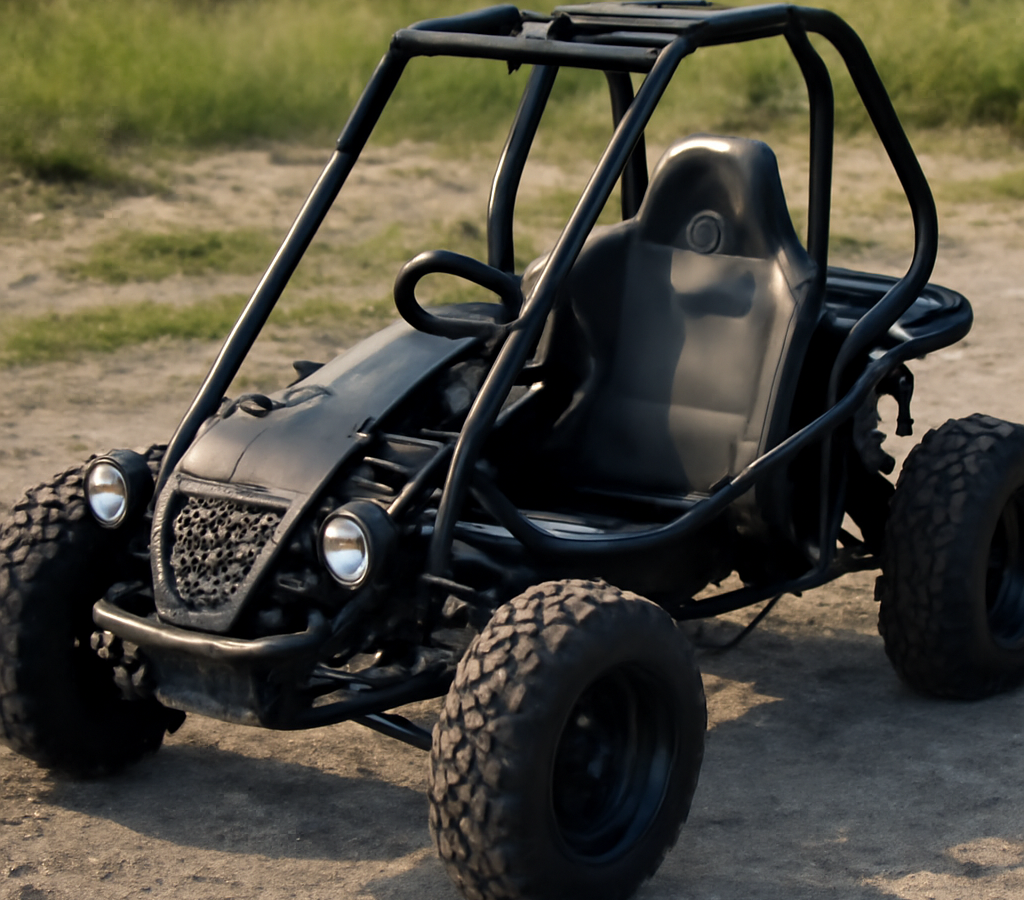
An off road go-kart for adults is built for a completely different job than a track kart: rough terrain, dirt, mud, hills, and trails instead of smooth pavement. That means bigger knobby tires, real suspension travel, higher ground clearance, and a torquey engine that pulls through loose ground. If you have room to roam on private land, an off-road kart delivers rugged, all-day fun that a low-slung racing kart simply cannot handle. This guide breaks down the types, the specs that matter for a full-size rider, how to choose the right machine, and the maintenance and safety habits that keep dirt driving fun.
What Is an Off Road Go-Kart?
An off road go-kart for adults is a recreational kart engineered to tackle unpaved terrain. Compared to a track kart, it sits higher off the ground, uses aggressive tread tires, and almost always includes some suspension, whether simple swing arms or full independent A-arms with coilover shocks.
These karts share DNA with UTVs and dune buggies but stay smaller, simpler, and cheaper. Most seat one or two people, use a chain-driven gas engine or a torque-rich electric motor, and prioritize durability and traction over outright speed. The goal is a machine that shrugs off ruts, roots, and mud instead of bottoming out on the first bump.
Types of Off-Road Karts
The category spans several distinct styles suited to different riders and terrain.
Trail and recreational karts are the mainstream choice: mid-size gas engines (150cc to 250cc), basic suspension, and seating for one or two. They handle trails, fields, and light hills comfortably.
Off-road buggies step up with roll cages, longer-travel suspension, and larger engines for rougher terrain and higher speeds. They blur into UTV territory.
Electric off-road karts use battery packs and deliver strong low-end torque with near-silent running, ideal where noise or fumes are a problem. Range is the trade-off.
DIY off-road builds let you tailor clearance, gearing, and suspension exactly to your land, starting from a purpose-built off-road frame.
Off-Road Kart Types Compared
| Type | Terrain | Top Speed | Seats | Typical Price | Best For |
|---|---|---|---|---|---|
| Trail / recreational kart | Trails, fields, light hills | 20-35 mph | 1-2 | $1,500-$4,000 | General adult off-road fun |
| Off-road buggy | Rough, rutted, steep | 30-50 mph | 1-2 | $3,000-$8,000 | Aggressive terrain, higher speed |
| Electric off-road kart | Trails, quiet zones | 20-30 mph | 1-2 | $2,000-$6,000 | Low noise, low maintenance |
| DIY off-road build | Whatever you design for | Varies | 1-2 | $800-$3,000 in parts | Custom clearance and gearing |
How to Choose an Off-Road Kart for Adults
Confirm the adult weight rating first. Look for a stated capacity that comfortably covers you plus a passenger if it seats two, and a steel frame rated for adult use rather than a scaled-up kids’ toy.
Match suspension and clearance to your terrain. Smooth trails need little; rocky, rutted land demands longer travel and higher ground clearance. Bigger tires improve both grip and clearance but can slow steering. Prioritize torque over top speed, because pulling through mud and up hills matters more than a high number on flat ground.
Weigh gas versus electric honestly. Gas gives longer range and quick refueling for all-day riding on big property; electric gives quiet, low-maintenance operation with limited range. For casual power comparisons across recreational machines, our electric go-karts complete guide is a useful reference, and how much a go-kart costs helps set a realistic budget.
Budget for total cost of ownership, not just the purchase price. Off-road karts consume tires, chains, air filters, and suspension bushings faster than pavement machines because dirt and impacts are punishing. Plan for periodic parts, fuel or battery replacement, and somewhere to store and transport the kart, since a full-size off-road machine will not fit in a car trunk. A slightly more expensive kart with good parts availability and a well-supported engine, such as a common clone motor, is usually cheaper to keep running than a bargain machine with obscure components.
Maintenance and Safety Basics
Off-road use is hard on machinery, so maintenance is frequent. After muddy or dusty sessions, clean the air filter, check the chain for grit and proper tension, and rinse suspension pivots. Inspect tires for cuts and keep pressures correct for traction and sidewall protection. Grease the suspension and steering joints on schedule, and check every bolt regularly because rough terrain vibration loosens hardware fast.
Driving technique matters as much as the machine off-road. Read the terrain ahead and pick a line that avoids the worst ruts and rocks rather than plowing straight through them. Keep your weight balanced and let the suspension work; fighting the wheel over bumps tires you out and reduces control. In loose dirt or mud, smooth, progressive throttle keeps traction, while stabbing the pedal just spins the tires and digs you in. Approach unfamiliar ground slowly until you know what is under the surface.
Safety is critical off-road because the terrain itself is the biggest hazard. Always wear a helmet, eye protection, gloves, and sturdy closed shoes, and use the seatbelt or harness every time. Choose a kart with a roll bar or cage, and drive within your sight lines: hidden ditches, rocks, and drop-offs cause most serious kart injuries. Take hills straight up or down rather than across the slope to avoid rolling, slow down in unfamiliar terrain, and never ride alone on remote land.
Pros and Cons
Off-road karts open up terrain no track kart can touch, but they cost more and demand space and upkeep.
Pros
- Handles dirt, mud, hills, and trails with ease
- Suspension and clearance soak up rough ground
- Two-seat models let you share the ride
- Rugged, durable, and genuinely versatile
Cons
- Needs open private land, not a driveway or track
- Higher purchase price than recreational karts
- More maintenance from dirt, mud, and vibration
- Rollover risk on slopes demands cages and harnesses
Frequently Asked Questions
What size engine does an adult off-road kart need?
How fast do off-road go-karts go?
Do off-road karts have suspension?
Are off-road go-karts street legal?
Gas or electric for off-road?
Can two adults ride one off-road kart?
Final Thoughts
An off road go-kart for adults is the right pick when you have land to explore and want a rugged machine that laughs at dirt and hills. Focus on a genuine adult weight rating, suspension and clearance that suit your terrain, torquey power, and a roll cage with harnesses. Then ride within your sight lines and keep up with maintenance. For related reading, compare power options in the electric go-karts complete guide, budget with how much a go-kart costs, cover the basics in the go-karting beginners guide, or consider a custom rig using the best go-kart kits and frames.