
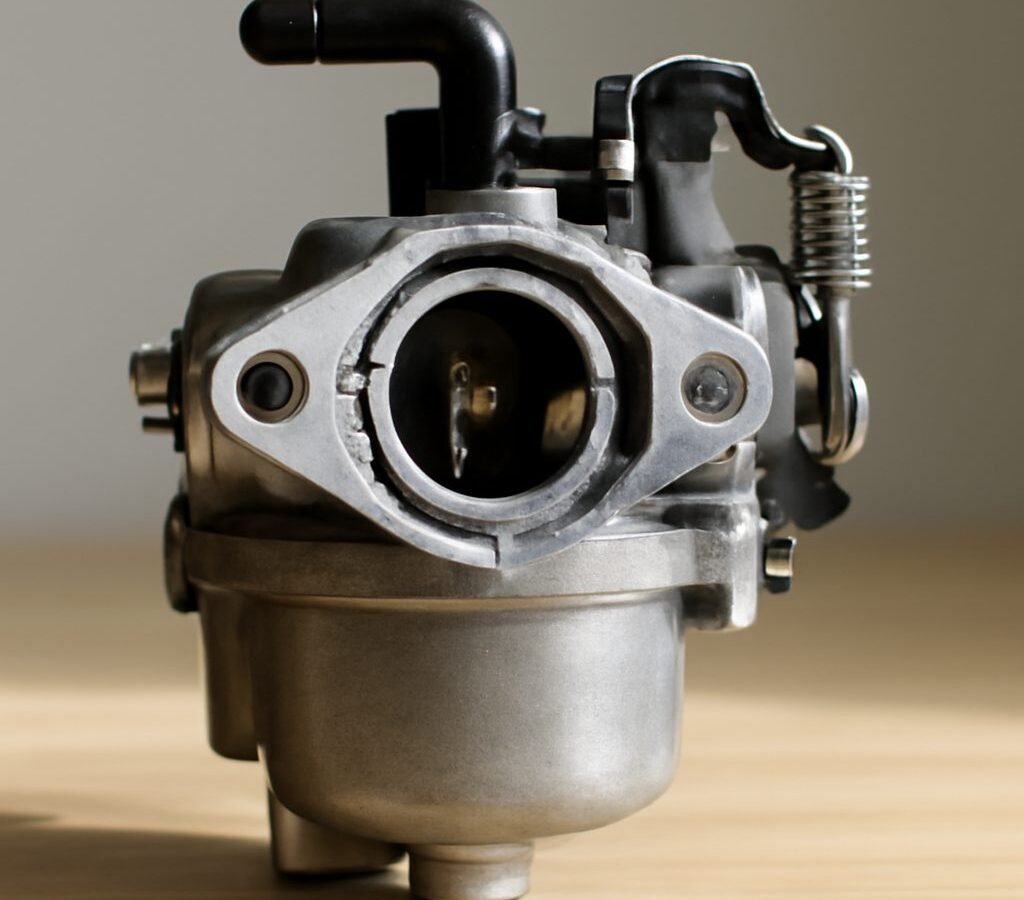
The Predator 212 carburetor is a small fixed-venturi float carb that meters fuel and air into Harbor Freight’s 212cc engine. On a stock engine it works well enough: it is tuned on the lean side for emissions and smooth idle, not maximum power. Problems start when you add breathing mods such as a high-flow air filter, an open header, or a cam, because the stock jetting cannot supply enough fuel. The usual fixes are cleaning, re-jetting the stock carb, or swapping to a tunable slide carb such as a 22mm Mikuni-style unit. This guide explains how the carb works, how to diagnose problems, when to upgrade, how to jet it, and what it typically costs.
Part of our Predator 212 & Clone Engines guide — explore the full guide →
How the Predator 212 Carburetor Works
The stock carb is a simple float-type design. Air flows through a narrow venturi, which lowers pressure and draws fuel up from the float bowl through the main jet and emulsion tube. A butterfly throttle plate controls airflow, and a choke plate richens the mixture for cold starts.
The float and needle valve keep the fuel level in the bowl constant, so the mixture stays predictable. At idle and very small throttle openings, a separate pilot (idle) circuit supplies fuel through tiny passages. Those passages are the first to clog when fuel sits and varnishes.
Both Hemi and non-Hemi versions of the engine use a broadly similar carburetor, though details such as mounting, linkage, and jet sizes can differ between production runs. If you are unsure which engine you have, our Predator 212 Hemi vs non-Hemi guide explains how to tell. For the bigger picture on the engine, see the Predator 212 engine hub.
Common Predator 212 Carburetor Problems
Most carb complaints come down to old fuel, dirt, or a mixture that no longer matches the engine’s mods.
- Hard starting or no start: often a clogged pilot jet, stale fuel, or a stuck float.
- Surging or hunting at idle: usually a partially blocked pilot circuit or an air leak at the intake gasket. Governor linkage problems can also cause it.
- Bogging when you open the throttle: typically lean, often after an air filter or exhaust change without re-jetting.
- Black smoke, fouled plug, fuel smell: running rich, from a jet that is too large, a stuck choke, or a float set too high.
- Fuel leaking from the bowl or overflow: a dirty needle valve or sticking float.
- Popping on deceleration: often a lean condition or an exhaust leak, common with open headers.
Reading the spark plug is one of the quickest diagnostic tools. Our Predator 212 spark plug guide shows what the color of the insulator tells you about the mixture.
Best Go Kart Carburetor: our top 3 picks
| Product | Best for | Key features | Price | Buy |
|---|---|---|---|---|
| TURBOTUNITY 196cc/212cc Carb | Best overall stock replacement |
| $13.99as of Oct 27, 2026 8:44 am EDT | Buy now →Check current price |
| YOXUFA VM22 Kit | Best performance upgrade kit |
| $29.49as of Oct 27, 2026 8:44 am EDT | Buy now →Check current price |
| QYMOTO KT196 Carb | Best for Coleman KT196 karts |
| $16.99as of Oct 27, 2026 8:44 am EDT | Buy now →Check current price |


Prices are Amazon’s listed prices as of the date and time shown and are subject to change; the price on Amazon at the time of purchase applies. As an Amazon Associate we earn from qualifying purchases.
How to Clean the Stock Carburetor
Before buying anything, clean the carb. It is cheap, takes an hour or so, and fixes a large share of running problems.
- Shut off the fuel, drain the bowl, and remove the air filter assembly.
- Disconnect the throttle and governor linkage, noting how they attach. A phone photo helps.
- Remove the carb from the intake studs and keep track of the gaskets and spacer.
- Remove the float bowl, float pin, float, and needle. Unscrew the main jet and emulsion tube.
- Clear every jet and passage with carb cleaner and compressed air. Use a fine wire or jet-cleaning tool only gently, since enlarging a jet changes the mixture.
- Inspect the needle tip and bowl gasket, replace them if worn, and reassemble with fresh gaskets.
To prevent repeat problems, use fresh fuel, add a stabilizer if the kart sits, and run the carb dry or drain the bowl before long storage.
Upgrade Options for the Predator 212 Carburetor
When cleaning is not enough, or your mods have outgrown the stock carb, these are the main paths.
Re-jet the stock carb. A slightly larger main jet suits mild mods like a high-flow filter or a less restrictive muffler. It is the cheapest upgrade and keeps the stock linkage and governor setup intact.
Replacement stock-style carb. If the original is damaged or badly corroded, an inexpensive replacement of the same design is often quicker than a rebuild. Quality varies, so expect to clean and check any budget unit before fitting.
22mm slide carb (Mikuni VM22-style). The most common performance swap. A slide throttle and tunable jet needle and main jet give finer control across the rev range, which suits builds with a cam, header, and filter. Genuine and clone versions exist; clones cost less but are more variable.
Larger race carbs. Bigger bores support heavily built, high-rpm engines but can make low-speed response worse on a trail or yard kart. Size the carb to the engine’s airflow needs, not to the biggest number available.
For specific products, see our best go-kart carburetor roundup, and for what a complete package should contain, read the go-kart carburetor kit guide.
Carburetor Options Compared
| Option | Best for | Tuning adjustability | Install effort | Typical cost (USD) |
|---|---|---|---|---|
| Clean and rebuild stock carb | Stock engines with running problems | Jets only | Easy | $5 to $20 |
| Re-jet stock carb | Filter or muffler mods | Jets only | Easy | $10 to $25 |
| Stock-style replacement | Damaged or corroded originals | Jets only | Easy | $15 to $40 |
| 22mm slide carb (VM22-style) | Cam, header, and filter builds | Main jet, pilot jet, needle, slide | Moderate | $30 to $120 |
| Larger race carb | Fully built high-rpm engines | Extensive | Moderate to hard | $80 to $200+ |
Prices are typical ranges for the category, not for any specific brand, and vary with whether adapters, cables, and jets are included.
How to Jet a Predator 212 Carburetor
Jetting means matching fuel delivery to the engine’s airflow. There is no universal “correct” jet size, because it depends on your mods, altitude, temperature, and fuel. Use the steps below as a method rather than chasing a number from a forum.
- Start from a known baseline. Note the jet that came in the carb and the mods you have fitted.
- Change one size at a time. Go up a step if the engine bogs, hesitates, or runs hot under load. Go down if it smokes, stumbles, or fouls plugs.
- Test under real load. Revving in neutral tells you little. Drive the kart and pull the plug after a hard run to read its color.
- Tune the right circuit. On a slide carb, the main jet matters most near full throttle, the needle at mid throttle, and the pilot jet at idle and just off idle.
- Account for altitude. Thinner air at elevation usually needs leaner jetting than at sea level.
When in doubt, err slightly rich. A rich engine runs a bit soft and dirty; a lean engine can overheat and damage the piston. An air-fuel ratio gauge removes much of the guesswork on modified engines.
Installing an Aftermarket Carburetor
Most slide-carb swaps need an intake adapter or manifold to mate the round carb to the 212’s port, a throttle cable that suits your pedal, and an air filter adapter. Some kits include these; many do not.
Seal every joint with the correct gaskets, because a small air leak causes a lean, erratic idle that looks like a jetting problem. Route the fuel line without kinks and away from the exhaust. Check that the throttle opens fully and snaps back closed.
A slide carb usually replaces the stock throttle linkage, which affects how the governor works. Many builders remove the governor at the same time, which raises rpm limits and brings real safety requirements. On a governor-removed engine, a billet flywheel and billet connecting rod are widely considered essential, because stock cast parts can fail violently at high rpm. Plan the carb as part of a matched package, alongside your air filter and Predator 212 exhaust.
How to Choose the Right Carburetor
Match the carb to your other mods. A bigger carb on an otherwise stock engine rarely adds useful power. Upsize only when the engine can use the extra airflow. Our best Predator 212 upgrades roundup lays out a sensible order of operations.
Decide genuine versus clone. A genuine slide carb tends to be consistent out of the box. A clone saves money and can run well, but plan on inspecting, cleaning, and possibly re-jetting it.
Buy jets with the carb. A small assortment makes tuning far faster than waiting for one jet at a time.
Favor drivability. On a yard, trail, or fun kart, crisp low and mid-range response matters more than peak power. A modest carb tuned well usually feels quicker than an oversized one tuned poorly.
Pros and Cons
Getting the carburetor right is one of the highest-value jobs on a 212, with a few honest trade-offs.
Pros
- Cleaning and re-jetting fix most running problems cheaply
- Slide carbs offer fine tuning across the rev range
- A matched carb unlocks gains from filter and exhaust mods
- Parts are inexpensive and widely available
Cons
- A bigger carb adds little on a stock engine
- Poor jetting can run lean and damage the piston
- Clone carbs vary in quality and need checking
- Carb swaps often lead to governor removal and its safety demands
Frequently Asked Questions
Does the Predator 212 need a carburetor upgrade?
What carburetor fits the Predator 212?
Why does my Predator 212 bog after adding an air filter?
How do I know if my carburetor is running rich or lean?
Can I clean the stock carburetor instead of replacing it?
Do I have to remove the governor to install a slide carb?
Final Thoughts
The Predator 212 carburetor rewards a matched, methodical approach. Clean it first, re-jet it for mild mods, and move to a tunable slide carb only when the rest of the engine can use the extra airflow. Jet it carefully and lean toward rich while you test. If your carb swap leads you toward higher rpm, put the billet flywheel and rod on the list before you chase speed.